
When words go offline (plus a gift for your practice) 🎁
Rethinking How We Meet Client Shutdown in the Therapy Room
I’ve spent the last 2 weeks battling accounting software and, though it was touch and go at times, I’ve come out the other side the victor!
To make up for the missed articles and to celebrate my success, I return with a gift! Read on to find out more...

Some clients arrive in quiet. Instead of the traditional first session torrent of words, we read unease in bum shuffles, twisted fingers and eyes darting towards the door. For some young people, communication has never felt safe or even been heard.
We have strategies to support this for sure: creative work, games, art making, and emotion cards. These tools are great. However, when someone who already struggles with verbal communication arrives at a session already under stress, or reacts to a difficult topic in a session, their ability to find and express words can become impossible. As therapists, our instinct is to lean in. We might soften our voice and gently prompt: “What’s happening inside right now?” or “Can you tell me where you feel that in your body?” But if a client has entered a true freeze or shutdown state, those gentle questions can accidentally come across as demands they cannot fulfil. Communicating basic therapeutic needs is vital to supporting your client, the relationship, and keeping the therapy space safe. When “I Don’t Know” Means “I Can’t Speak”
Ethan had been coming for a while now, but he still hovered in the doorway like an unwanted guest with a backpack of developmental trauma. I ushered him in and asked him about his latest game. It was a sure-fire way to help him relax. He told me about the latest battle, and his sniper technique. He’s been asked to lead the team and was clearly fizzing with pride. I was so grateful for his online world. At home, he was downtrodden, the misfit, the scapegoat in the family narrative, and he carried the weight of that into school, his slumped body language a target for bullies. In the late hours, he had a team that valued him, who fought and won battles, and I got the pleasure of meeting this confident, jovial part of him, the young person who would have been with family support.
For weeks, our pattern looked like this: Ethan would shut down, and I would try to gently talk him back into the room. Occasionally, it worked. Today it didn’t, something had happened at home either last night or this morning. When I asked open-ended questions to explore the silence, he became more frozen, eventually shaking his head, forcing out a hoarse, undecipherable whisper, just to appease the pressure of the room.
We were hitting a wall. Forcing Ethan to use words to explain his wordlessness would add more pressure to a nervous system that had already shut down.
I realised we needed a bridge. We needed a low-demand, non-verbal way for Ethan to have some autonomy over our space and communication without needing to speak a single sentence.
The next week, I introduced a simple set of visual cue cards. I placed them openly on the table between us before the session even started. I told him, “If you don’t have words at any point today, you don’t have to force them. Just point to a card, or flip one over. Whatever the card says, we will do, no questions asked.” Ethan flipped through them, but didn’t need them that day.
Two sessions later, the shutdown happened. The tension entered the room before he did, the air fizzing with anxiety. But this time, instead of the frantic internal panic of trying to form a sentence, Ethan slowly reached out and slid a card toward me.
It read: “Please don’t look directly at me for a few minutes while I reset.”
I immediately dropped my gaze, shifted my posture slightly away, and let the room go completely quiet. A few minutes later, Ethan took a deep breath. His shoulders dropped. By respecting his nervous system’s boundaries without demanding an explanation, we co-regulated. He didn’t have to perform “the good client” for me; he just had to exist until his brain came back online.
Introducing the Branch Communication Cards
That type of experience, alongside many others in my clinical work, is why I designed the Branch Communication Cards.
This deck is built as a non-verbal, trauma-informed toolkit to help clients advocate for their immediate sensory, environmental, and relational needs when they are feeling flooded or disconnected. The cards cover three distinct areas of need during a session:
Internal State Identifiers: Simple, clean phrases like “My brain has gone offline,” “I feel completely numb, blank, or disconnected,” or “I might look distressed, but I am actually okay to keep going.”
Sensory & Environmental Control: Immediate requests for comfort, such as “Please can we dim or turn down the lights? “ or “Can I move to a different seat, sit on the floor, or change how I’m sitting? “
Relational Prescriptions: Direct guidance for the therapist on how to adjust their presence, including “Please ask me YES or NO questions only for a little bit “ or “Please just sit quietly with me. You don’t need to fix this or say anything.”
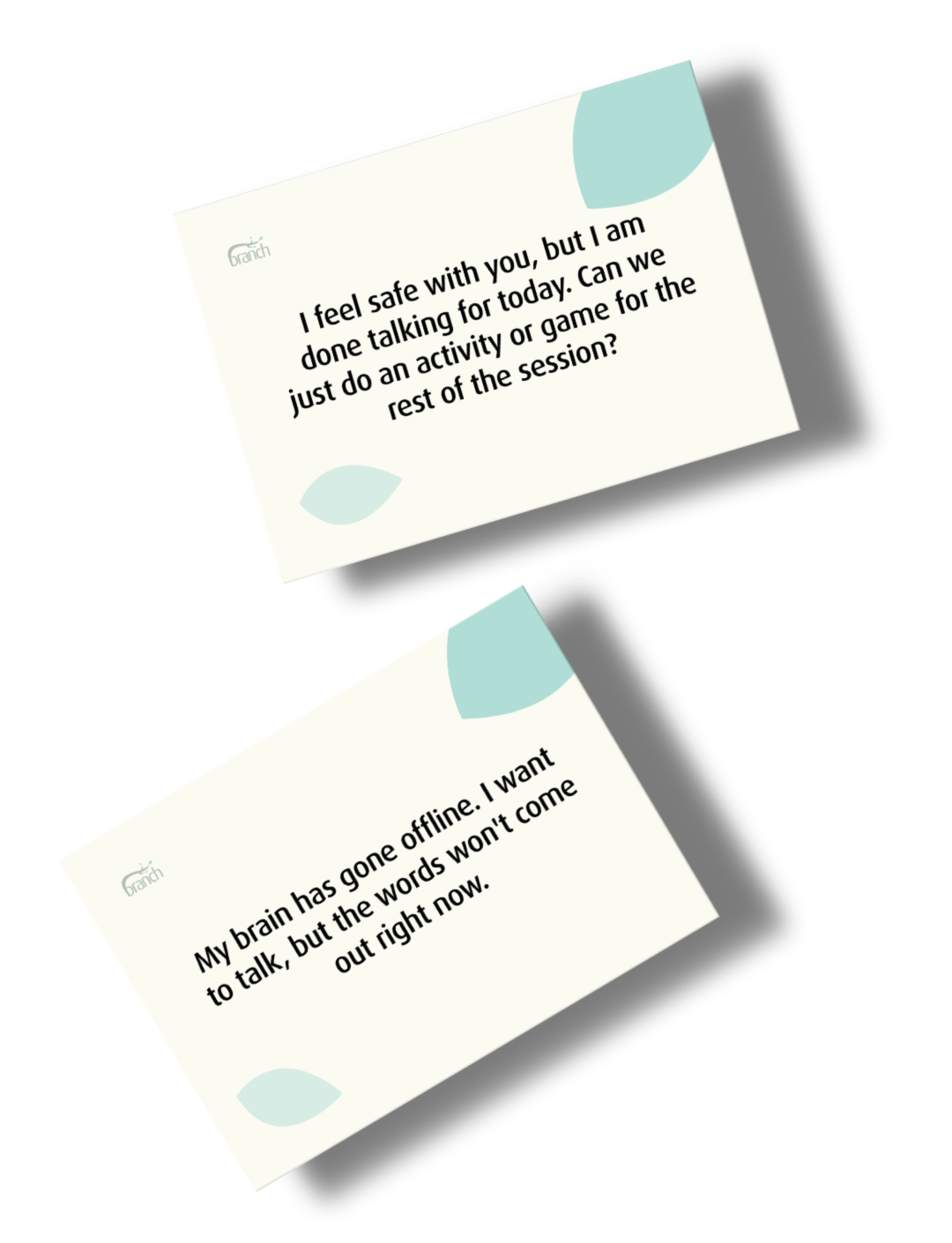
When we hand these tools to our clients, we aren’t just giving them a piece of paper. We are actively creating a safer therapeutic frame. We are showing them that their silence is welcome, their boundaries are absolute, and that we are willing to change our behaviour, or the room, to meet them exactly where their nervous system is sitting.
A Gift For My Substack Community
As I develop more resources through Branch Counselling & Tools, I want to share them with the practitioners who make up this community first.
Before these cards are added to our website as a permanent digital download product next week, I am offering the complete printable PDF deck entirely for free to my Substack subscribers for the next 7 days. You can download the high-resolution file below, print them out (they look beautiful on heavy cardstock or matte paper), and cut them along the guidelines to begin using them in your practice right away.
📥 DOWNLOAD YOUR FREE COMMUNICATION DECK Just enter the code SUBSTACK, all caps, at checkout. (Link active until 04/07/26)
I would love to hear how you use them. If you introduce them to your clients, drop a comment below or reply to this email to let me know how it shifts the co-regulation and safety within your therapeutic room.
It’s lovely to share a few quiet moments with you today.
Until next time,
💛🌿 Helen
About the Author: Helen Gifford is a counsellor, supervisor, and author of ‘A Practical Guide For Working Therapeutically with Teenagers and Young Adults’.
Support this work: 📕 Order the Book: A Practical Guide for Working Therapeutically with Teenagers and Young Adults ☕ Buy me a toasted teacake: Ko-fi 🌿 Work with me: Clinical Supervision and Training via www.branchcounselling.co.uk
Author Note & Transparency: All case studies or stories are fully fictitious to illustrate the experiences many professionals face; no confidentiality has been broken. I recommend resources based on a combination of clinical experience and consideration of available evidence. These are offered for interest only and are not endorsements of scientific efficacy or clinical recommendations. Please apply your own critical judgment.