
Giants Online, Meek in Reality: Bridging the Gap in YA Therapy
Rehearsing for Reality: A Practical Guide to RPGs in Youth Therapy
“Yeah, fine,” Leo shouted downstairs to his Mum, shutting her and her questions out quickly.
He shrugged off his jacket and college lanyard, sliding on a well-worn, soft hoodie. Leo had learned quickly that it was easier to avoid his Mum. It was getting harder to look her in the eye and tell her that he’d had a “good” day. His dreams of college life had fallen flat; he’d struggled with being away from his school friends, his confidence draining out of his slumped shoulders by the end of every afternoon.
Moving a pile of washing to one side and swinging into his chair, he booted up two screens: the loading page of his game and his Discord server. Cracking his fingers and rolling his shoulders, he settled into work.

Photo by Linus Sandvide on Unsplash
As the moderator of a 200-member gaming community, there was a raft of notifications, complaints, and cries for support to manage. He was taking two groups out tonight: an early-evening training run for the “newbies” and a late-night competitive match with his core team, including an old schoolmate.
By 2 a.m., he stretched out in bed, owning his space with a deep sense of satisfaction. He had received numerous thank-yous from his trainees after handing out virtual coin and strategy advice, and he felt like a king after leading his pro group to victory. He kept the looming thought of tomorrow’s college classes tucked away in a dusty corner of his mind, just to keep the glow a little longer.
Leo had been going to counselling for a while. His counsellor, Ash, found his polarised worlds fascinating. It was as if Leo were two entirely different people: a meek, small, and anxious student in the daytime, and a larger-than-life, charismatic leader at night.
Ash got to meet both versions in the counselling room. But while she felt the gaming version was actually Leo’s authentic, relaxed self, she struggled to find a bridge to merge these two worlds. Standard talking therapy felt too exposing for his daytime persona, and traditional games like Jenga felt too childish to reach the leader of armies.
So, Ash decided to invite Leo to a therapeutic role-playing game (tRPG) group that she co-facilitated with a colleague.
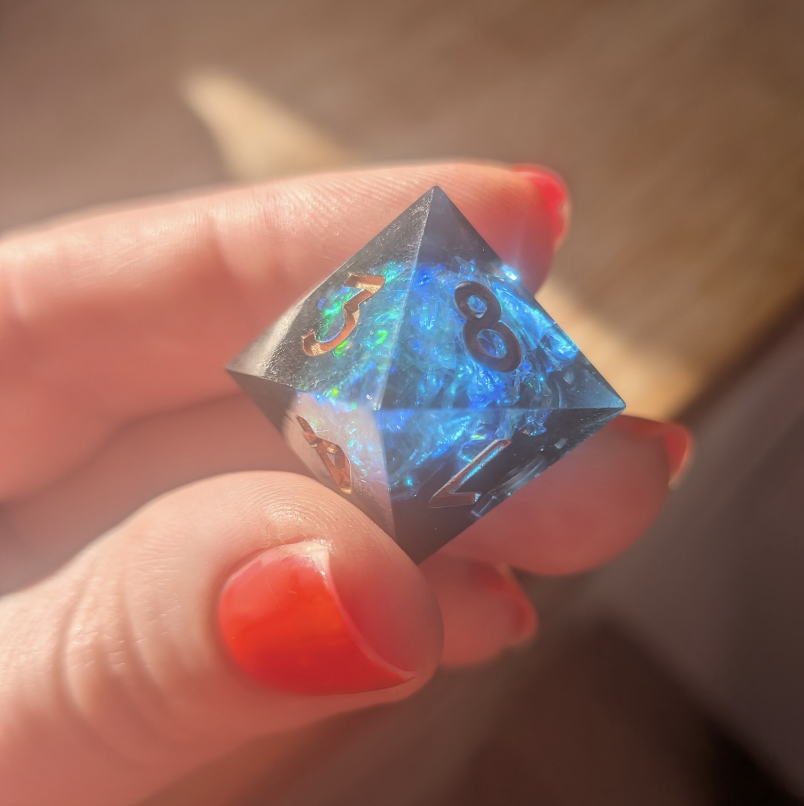
My new dice!
In this space, Leo played a character: a strong, resilient fighter named Valen. But unlike his online video games, the narrative here wasn’t fixed. The battles and puzzles hadn’t been pre-mastered by YouTube tutorials. The struggle between his two worlds was present from the very first roll of the die; Leo hesitated to take the lead, and Ash watched with cautious hope.
Then, the curated digital armour cracked.
Staring at a natural ‘2’ on his twenty-sided die (a d20), Leo felt a blooming heat of humiliation. He was going to lose this fictional fight, and there was nothing he could do about it. His real-world fear of inadequacy flooded the table. His knee began to bounce violently; every part of him wanted to bolt from the room.
Ash fought the urge to step in, trusting the group dynamic.
A feisty cleric at the table (played by a peer, Sasha) laughed, but not unkindly. Just as Leo started to physically recoil, she announced in her squeaky character voice, “We can’t lose a party member now!” She turned to the Games Master (GM): “Can I use my reaction to cast Healing Word?”
Ash offered an almost imperceptible nod to her co-facilitator, who was already reading the room. Without over-pathologising Leo’s visible anxiety, and ignoring the fact ‘healing word’ should be a bonus action on Sasha’s turn, not a reaction, the GM replied smoothly, “Of course. What does that look like as you cast it?”
Together, the party shielded Valen from further harm and took out the attacker. No one judged Leo. No one commented on his failure, save for a casual, “Ah, unlucky roll, mate.”
Before Leo could spiral, they were into the next puzzle. Sasha asked Valen to use his brute strength to smash open a locked chest. Leo rolled a 19. He stood up, acting out a swinging power move, while his teammate boomed, “CRASH!” as the imaginary steel axe hit the wood.
The divide between Valen and Leo began to fade. Camaraderie and self-development built hand-in-hand, roll by roll.
Instead of letting him “log out” or emotionally withdraw after the session, the therapists helped the group pause and reflect. The other young adults didn’t mock his bad roll; their characters had stepped in to save him. Leo learned a profound relational lesson: he didn’t have to be a flawless digital god to be accepted. He could fail and still be safe.
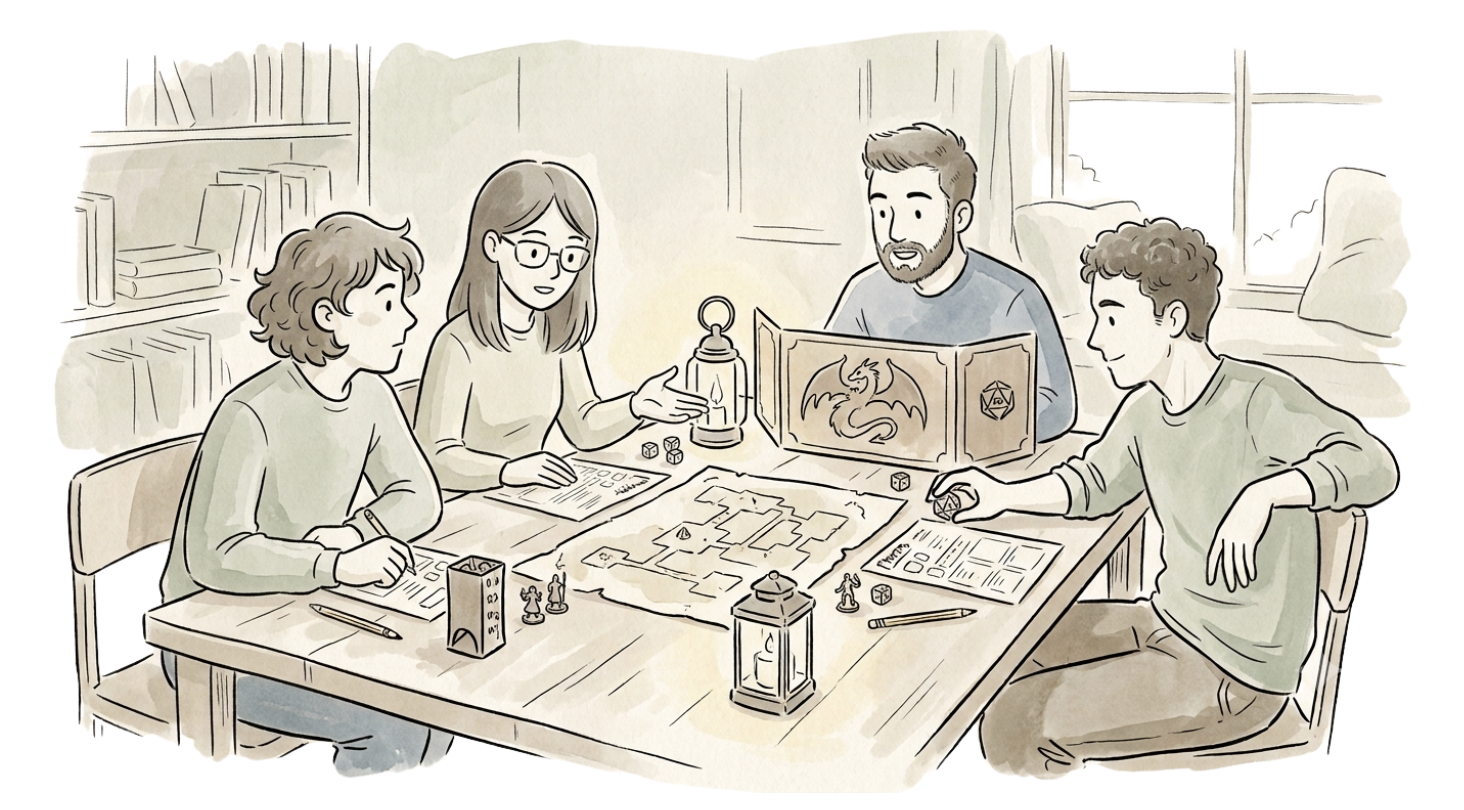
AI generated.
Back in his individual sessions, Ash and Leo began to bridge the gap. They talked about how it takes genuine, transferable skill to manage a 200-person Discord server, mentor beginners, and recognise when to rely on a team. Slowly, Valen’s character development began to bleed into Leo’s real life.
Moving Beyond Jenga: Why Therapists Benefit from tRPGs
As therapists working with teenagers and young adults, we often fall back on classic board games to break the ice. We write emotions on Jenga blocks or use Connect Four to regulate hyperarousal. While these have their place, they lack a crucial therapeutic element: narrative projection within a social matrix.
When we introduce Tabletop Role-Playing Games (like Dungeons & Dragons) or therapeutic board games into our practice, we aren’t just “playing.” We are utilising what clinical research calls the “Bleed” effect, the bidirectional flow of emotions, traits, and experiences between a player and their character, within the system of their teammates.
Here is why expanding your toolkit to include fantasy and RPGs matters for young adult clients:
The Safe Psychological Distance: Playing a character provides an “as-if” scenario. It allows a highly defended young person to explore their deepest vulnerabilities (like fear of failure or rejection) because it is happening to Valen the Fighter, not Leo the Student.
Experiential Relational Testing: In a video game, if you fail, you hit ‘Restart.’ In a tRPG group, when you fail, you must sit in the uncomfortable space of being witnessed by peers. When those peers choose to protect you instead of mock you, it corrects the client’s negative relational schemas in real-time.
Co-Regulation in Vivo: As co-facilitators (one acting as the GM/Narrator and the other as a clinical observer/player), we can gently manipulate the game’s tension to match the group’s window of tolerance. We can pause the narrative to co-regulate a client right as their “armour cracks.”
For our young people who are isolated in their rooms but giants online, fantasy isn’t an escape from reality; it is the rehearsal stage for it.
It’s lovely to share a few quiet moments with you today.
Until next time,
💛🌿 Helen
About the Author: Helen Gifford is a counsellor, supervisor, and author of ‘A Practical Guide For Working Therapeutically with Teenagers and Young Adults’.
Support this work: 📕 Order the Book: A Practical Guide for Working Therapeutically with Teenagers and Young Adults ☕ Buy me a toasted teacake: Ko-fi 🌿 Work with me: Clinical Supervision and Training via www.branchcounselling.co.uk
Author Note & Transparency: All case studies or stories are fully fictitious to illustrate the experiences many professionals face; no confidentiality has been broken. I recommend resources based on a combination of clinical experience and consideration of available evidence. These are offered for interest only and are not endorsements of scientific efficacy or clinical recommendations. Please apply your own critical judgment.
Recommended References and Further Reading
I found a particular issue of The Journal of Role Playing particularly helpful, and my Substack friends - it is free to access! Pointers to highlights below.
1. The “Bleed” Effect and Identity Transformation
Hugaas, Kjell Hedgard (2022). “Bleed and Identity: A Conceptual Model of Bleed and How Bleed-out from Role-playing Games Can Affect a Player’s Sense of Self.” International Journal of Role-playing 15.
Walsh, Orla, and Linehan, Conor (2024). “Roll for Insight: Understanding How the Experience of Playing Dungeons & Dragons Impacts the Mental Health of an Average Player.” International Journal of Role-playing 15.
Baird, Josephine (2021). “Role-playing the Self: Trans Self-Expression, Exploration, and Embodiment in (Live Action) Role-playing Games.” International Journal of Role-playing 11.
2. Role-Play as a “Rehearsal Stage” for Life
Bartenstein, Lennart (2024). “Live Action Role-playing (Larp) in Cognitive Behavioural Psychotherapy: A Case Study.” International Journal of Role-playing 15.
Sottile, Emry (2024). “It Might Have a Little to Do with Wish Fulfilment”: The Life-Giving Force of Queer Performance in TTRPG Spaces.” International Journal of Role-playing 15.
Cullinan, Maryanne (2024). “Surveying the Perspectives of Middle and High School Educators Who Use Role-playing Games as Pedagogy.” International Journal of Role-playing 15.
3. Narrative Projection and Processing Trauma
Lehto, Kerttu (2024). “Nordic Larp as a Method in Mental Health Care and Substance Abuse Work: Case SÄRÖT.” International Journal of Role-playing 15.
McAdams, Dan P. (2011). “Narrative Identity.” In Handbook of Identity Theory and Research.
4. Professional Manuals and Clinical Models
Connell, Megan (2023). Tabletop Role-Playing Therapy: A Guide for the Clinician Game Master. W. W. Norton & Company.
Kilmer, Elizabeth D., et al. (2023). Therapeutically Applied Role-Playing Games: The Game to Grow Method. Routledge.
Bowman, Sarah Lynne, and Hugaas, Kjell Hedgard (2021). “Magic is Real: How Role-playing Can Transform Our Identities, Our Communities, and Our Lives.” In Book of Magic: Vibrant Fragments of Larp Practices.