
Room For Two: Navigating In-Session Mirroring
Moving around the house that morning felt like moving through palpable tension; her heart paused, ready for the tentative routines to rupture into cross words, spat with spite. She eyed the kettle, considering if the caffeine hit was worth the extra 2.5 minutes of risk, or if getting out and having the cheap dust in the office was easier. Heavy footsteps loomed down the stairs, and her nerves decided for her. Head dipped, utilising her fringe as a shield, she mumbled “have-a-good-day” and rushed out to the sanctuary of her car.
Spotify streaming her favourite podcast, the familiar voices providing a background of safe familiarity, cool air blowing, the low rumble of the road beneath. The journey allowed her to switch paces, from uncertain, timid, lost to a capable, helpful adult. She didn’t know how her relationship had become so broken, when the inhale of joy they had at the sight of each other became an exhale of despair, but it seemed beyond repair.
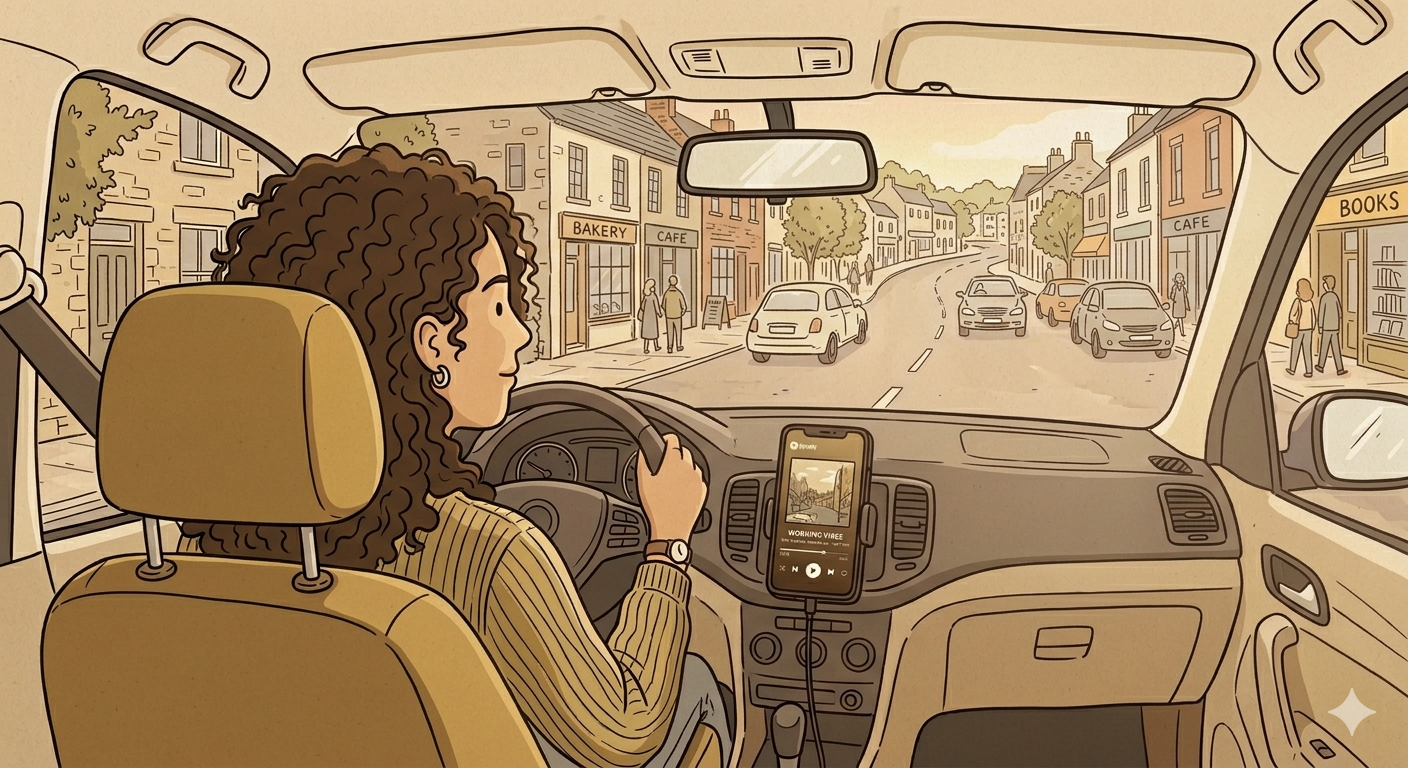
An AI generated image - a simple line illustration, a view from behind of a woman driving up a high street listening to spotify.
Isla sat in the chair opposite her small therapy room, her energy escaping the bounds of the seat, knees and curls bouncing in agitation.
“Millie, I don’t know what to do. I don’t think he loves me anymore. We haven’t had a fight or anything, but when he looks at me, there is nothing behind his eyes. I think it’s over!” Tears glistened, threatening to fall.
Outwardly, Millie’s eyes only widened slightly, but internally every muscle tensed. Her client was nearly 20 years younger than her, in the throes of teen romance, very different to her marriage of 10 years, but in that moment, she empathised fully with her client. Isla’s tears felt uncomfortably like Millie’s own.
“I don’t know what to do!” Isla’s cry had become close to a wail as the tears escaped, and Millie stopped herself from glancing to the door, worrying if anyone in the corridor could hear.
“You don’t need to decide anything right now, or even today. Take a moment to breathe.”
Millie took the breath with Isla, feeling some of the tension release with her exhale, wondering whose benefit she was really doing this for.
“Right now, what do you know?”
Isla stared at Millie, “Huh?”
“Well, it sounds like you have a sense of change in Dal, and a gut instinct that things are not ok. A gut instinct is very important, I am not dismissing that, it lets us know you need more information, but it is not enough to make a decision by itself.” She looked pointedly at Isla. “Do we know that his feelings have changed? Do we know if something has changed or if it can’t be fixed?”
Isla stared through Millie in deep thought. “I suppose... I suppose I don’t know for sure; I don’t have evidence. In theory, it could be something else, maybe?” Her words were tentative, but the tears had slowed to a gentle trickle.
Millie added quietly, “You’ve been together a while.”
Isla nodded, her voice almost a whisper, “He deserves a conversation.”
Millie repeated Isla’s words, “He deserves a conversation.”
As she started to write up the notes, Millie couldn’t escape those words. He deserves a conversation. She was a therapist, and if she was honest, she had been avoiding a conversation for months. Isla had gotten there before she had, or had she led her to it? Maybe they had helped each other.
In another app, Millie made a note for her upcoming supervision. She didn’t think she had let her own relationship woes impact what she had said to Isla, but she wanted to be sure, and her supervisor was a safe place to check this out. Then she wrote a message to her husband: “I’ll make tea, can we have a chat tonight?” Once these jobs were done, she could turn her full attention back to Isla’s world.
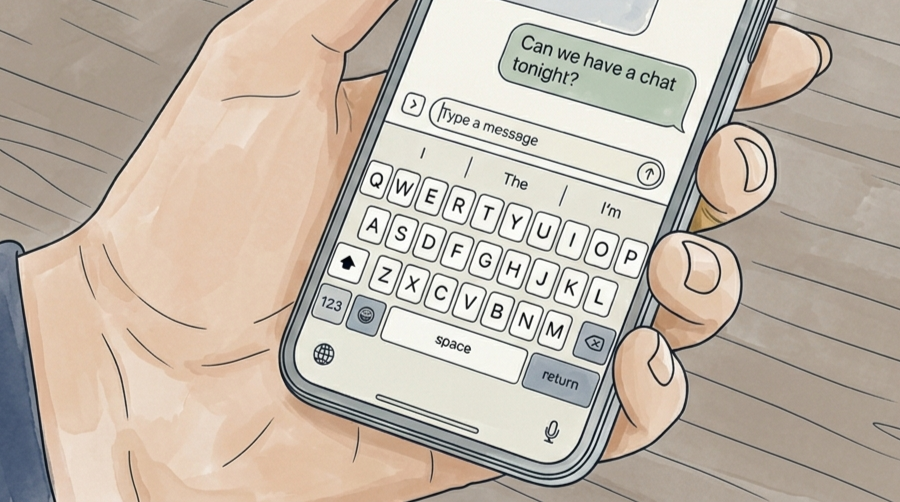
An AI generated image - a close up of a phone in hand, showing the message “can we have a chat tonight?”
Therapeutic Application: The Wounded Healer’s Compass
It is a quiet, often unspoken truth in our profession: we frequently end up giving our clients the exact clinical guidance we are hiding from in our personal lives. When a client’s narrative perfectly mirrors the therapist’s private pain, it creates a psychological flashpoint, when the ‘lightbulb moment’ is actually ours.
Here is a breakdown of the mechanics at play in Millie and Isla’s session, and how practitioners can safely navigate these moments when worlds collide.
1. The Podcast as a “Boundary Buffer”
The transition to work highlights a vital tool for practitioner longevity: the role-transition ritual. Millie uses her morning commute, specifically here a familiar podcast, to intentionally shift identities.
The Clinical Mechanism: When our home environment is a source of hyper-vigilance, we cannot simply step across an office threshold and magically become a grounded clinician. The car ride acts as a transitional buffer. It allows Millie to move from a “timid, lost” partner into her professional persona: the capable, boundaried adult.
This transition is important even if your home life is perfectly content, keeping some clarity between the spaces, your stuff and your clients’ stuff. This may be your commute, the watch you put on, different clothing, music, whatever works for you.
2. Concordant Countertransference: When Tears Mirror Tears
When Isla wails, Millie experiences a wave of concordant countertransference, a phenomenon where the therapist experiences the same emotional state as the client.
Internal Tension as Data: Countertransference is often discussed in training manuals as a risk to be managed, but in practice, it is an information goldmine. Millie does not let her emotions spill into the room. She doesn’t cry with Isla, nor does she over-disclose. Instead, she uses her own sudden internal tension as a barometer to realise just how shattering this relational shift feels for Isla. She anchors herself somatically by taking the deep breath with her client, co-regulating both of their nervous systems simultaneously.
3. Separating Instinct from Evidence
Millie’s intervention can also be called cognitive restructuring, particularly effective for young adults (16–25) who are navigating early relationship milestones.
The Emotional Trap: Young adults facing relationship anxiety are highly prone to catastrophising and mind-reading. When they sense a shift in a partner’s energy, they often leap straight to the final conclusion: It is over; they don’t love me.
The Intervention: Millie does something important; she validates the “gut instinct” without treating it as an absolute fact. By asking “Right now, what do you know?”, she gently forces Isla to separate emotional intuition from objective data. It stops the panic spiral, slows the tears, and grounds the young client back in reality, without dismissing or belittling Isla’s concerns.
4. The Supervision Safety Net and the Human Loop
The true mark of Millie’s reflection happens after the client leaves the room. She recognises the “bleed” between her life and Isla’s, and she takes immediate, ethical action.
The Professional Guardrail: Millie doesn’t panic or pathologise her reaction. Instead she immediately logs the encounter for clinical supervision. Supervision is not just for tracking client progress; it is a dedicated, objective space to ensure our personal blind spots are not unintentionally directing the client’s autonomy.
Ultimately, Millie allows her client’s breakthrough to constructively echo into her own life. In helping Isla find the courage to face an uncomfortable truth, Millie remembers how to use her own voice. It is a beautiful reminder that the therapeutic relationship is a living, human loop, and sometimes, the passenger in the room helps us steer our own course home.
Reflection - how do you hold the boundaries and the care when your client’s stories come close to your own? Do you use other strategies to support concordant countertransference?
It’s lovely to share a few quiet moments with you today.
Until next time,
💛🌿 Helen
About the Author: Helen Gifford is a counsellor, supervisor, and author of ‘A Practical Guide For Working Therapeutically with Teenagers and Young Adults’.
Support this work: 📕 Order the Book: A Practical Guide for Working Therapeutically with Teenagers and Young Adults ☕ Buy me a toasted teacake: Ko-fi 🌿 Work with me: Clinical Supervision and Training via www.branchcounselling.co.uk
Author Note & Transparency: All case studies or stories are fully fictitious to illustrate the experiences many professionals face; no confidentiality has been broken. I recommend resources based on a combination of clinical experience and consideration of available evidence. These are offered for interest only and are not endorsements of scientific efficacy or clinical recommendations. Please apply your own critical judgment.