
The Polished Professional, The Force, and The Quiet Kid:
Why I wouldn't always recognise my clients out of session.
Sometimes it can seem that the person we meet in the counselling room isn’t the same as the one we pass in the hallway, or the person described in the referral, or even in the words they use to describe themselves. I’ve heard clients - and other professionals - wonder which version is the real self. We live within systems that demand simple labels. We like people neat; it makes our plans, expectations, and those systems easier to manage. We like to know who is dependable, who is quiet, who is trouble, and who is in charge. But when the door closes, and the busy noise of the institutions recedes, those labels quickly dissipate.
At work, some look at Rani with awe and others with intimidation. She arrives with a confident sashay, face perfectly contoured, clothing appropriate but quirky, fully present in every meeting, asking the deep questions and getting the job done. But whilst efficient and present, she is also somewhat elusive, always rushing off somewhere important. The rumours range from being ‘goals’ to having an affair with the boss. I have never met this version of Rani; my client arrived head bowed, quietly spoken, hands clenched to minimise the shakes. Work is barely mentioned as Rani shares her exhaustion; she’s a carer for her young siblings as her mum’s an alcoholic. The poised professional self isn’t a lie; it is a suit of armour built to keep the world from seeing the unpolished stand-in mother underneath.
In organisations and institutions, success comes in many forms. For some, it is perfectionism; for others, it is absolute authority. Mrs Murphy has earned her reputation; she rules through fear but is fair (offering her care quietly), creating generations of children who leave school with an amazing mastery of mathematics and respect. Staff revere her, and there is often an adult waiting at her door with students at the end of each day, hoping for reassurance and advice. Her voice can reach the end of the longest school field with power, and she holds her head up with the confidence she deserves. I have only been told of this person because, behind my door, she sobs as she faces retirement. Her entire identity is in school; not being needed, not having that respect feels like a type of death. Outside, she holds up the institution; inside, she fears that without it, she will cease to exist.
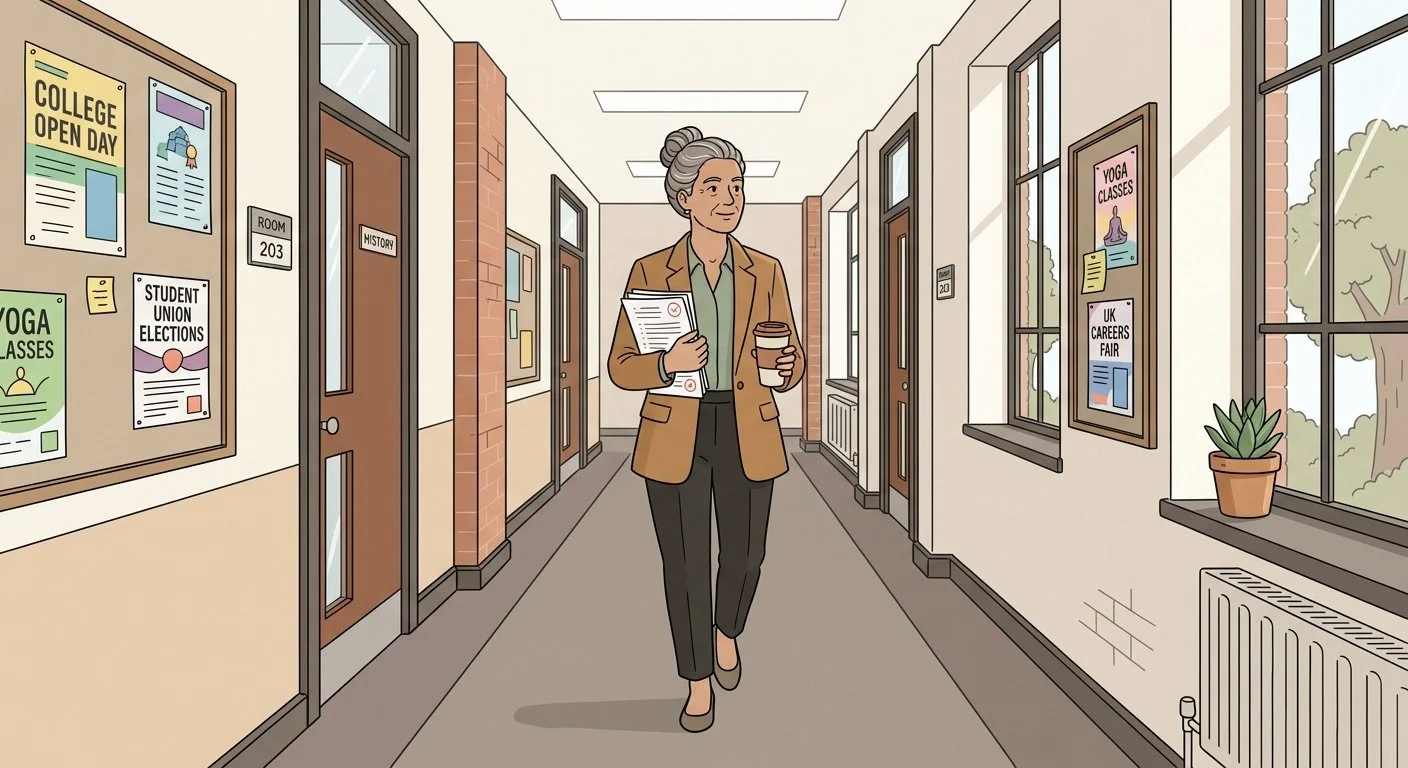
An AI image of an older female teacher confidently walking down a school hallway.
And then there are those who protect themselves not by taking up space, but by shrinking until they barely take up any at all. Holly was almost invisible, a young person who tries to melt into the walls, speaks so softly no one bothers to try anymore. No friends, no connections outside of the house, a painful, ghostlike existence. In the counselling room, Holly covers her mouth in shock as she belly laughs. I share in the laughter as we talk about the recent episodes of their favourite manga series. Over time we begin to use the characters to explore who Holly is. I learn about Holly as a creative with a passionate imagination and strong empathy. Her journals, musings and collages are a delight to behold, and I have to remind myself of the therapy, not just the enjoyment of her art.
We wouldn’t always recognise our clients out of session, sometimes because they unmask, or because they are exploring a path yet untravelled, a memory of what once was or a part of themselves yet to blossom; it doesn’t mean what we see is any more or less of who they are. We are multifaceted, and the therapy room is a great place to explore those facets.
We are privileged to explore in a neutral, safe space; we get to meet the different facets and hold a sandbox to play with ideas. In the outside world, changing your behaviour comes with social friction and immediate, potentially scary, consequences. If Holly speaks up, people react; if Mrs Murphy shows vulnerability, her authority feels compromised. The therapy room is the rare place where the stakes drop.
Here, the sandbox allows clients to bring out the buried pieces, try on untried voices, and test what happens when they let their shoulders drop. They learn that the vulnerable, frightened, or joyful person inside the room doesn’t cancel out the formidable teacher or the capable colleague outside. They are not forced to live as just one piece of the puzzle. They get to be the whole, beautifully complex jigsaw.

Photo by Tanja Tepavac on Unsplash - a yellow jigsaw piece in a sea of grey.
It’s lovely to share a few quiet moments with you today.
Until next time,
💛🌿 Helen
About the Author: Helen Gifford is a counsellor, supervisor, and author of ‘A Practical Guide for Working Therapeutically with Teenagers and Young Adults’.
Support this work:
📕 Order the Book: A Practical Guide for Working Therapeutically with Teenagers and Young Adults
☕ Buy me a toasted teacake: Ko-fi
🌿 Work with me: Clinical Supervision and Training via www.branchcounselling.co.uk
Author Note & Transparency: All case studies or stories are fully fictitious to illustrate the experiences many professionals face; no confidentiality has been broken. I recommend resources based on a combination of clinical experience and consideration of available evidence. These are offered for interest only and are not endorsements of scientific efficacy or clinical recommendations. Please apply your own critical judgment.