
Cards in the Therapy Room
How Cards Change the Landscape of Therapy
Cards are one of the most versatile, expansive resources we can bring into the therapy room. If you are looking to explore their clinical possibilities, or just want to chat all things cards - read on!
(Be sure to check out the brief video below for a quick visual intro to some of the decks discussed below).
Cards are far more than icebreakers. Sitting face-to-face can be intimidating, activating a client’s defences or evoking a subtle sense of unease. For others, direct talking feels awkward, or they simply lack the verbal language to describe their inner narrative. Introducing a physical tool shifts the dynamic entirely: it diverts attention and creates a shared focus in the room, bringing ease.
The Spectrum of Decks
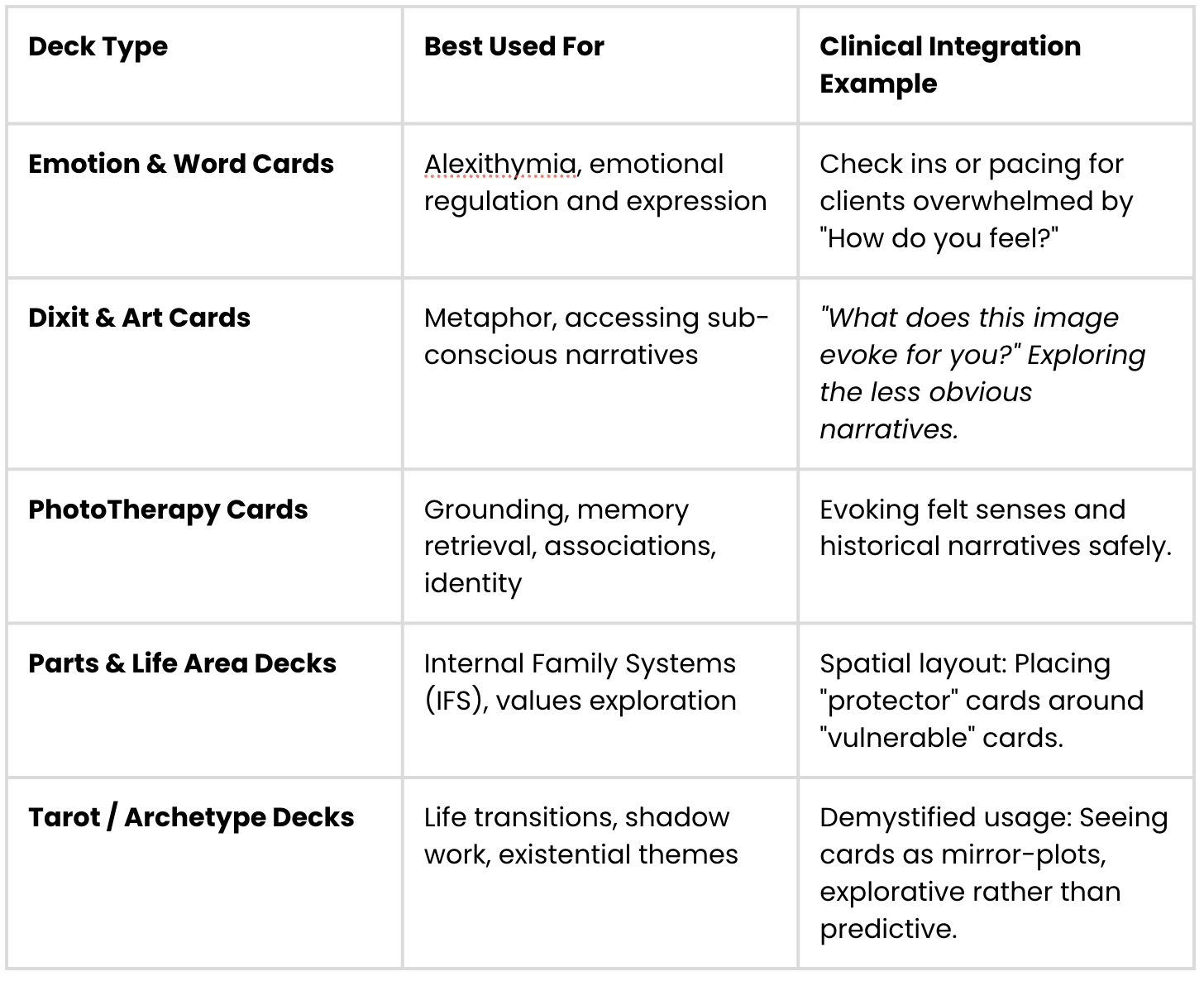
There is a vast range of cards available to practitioners, each offering a different way into client work:
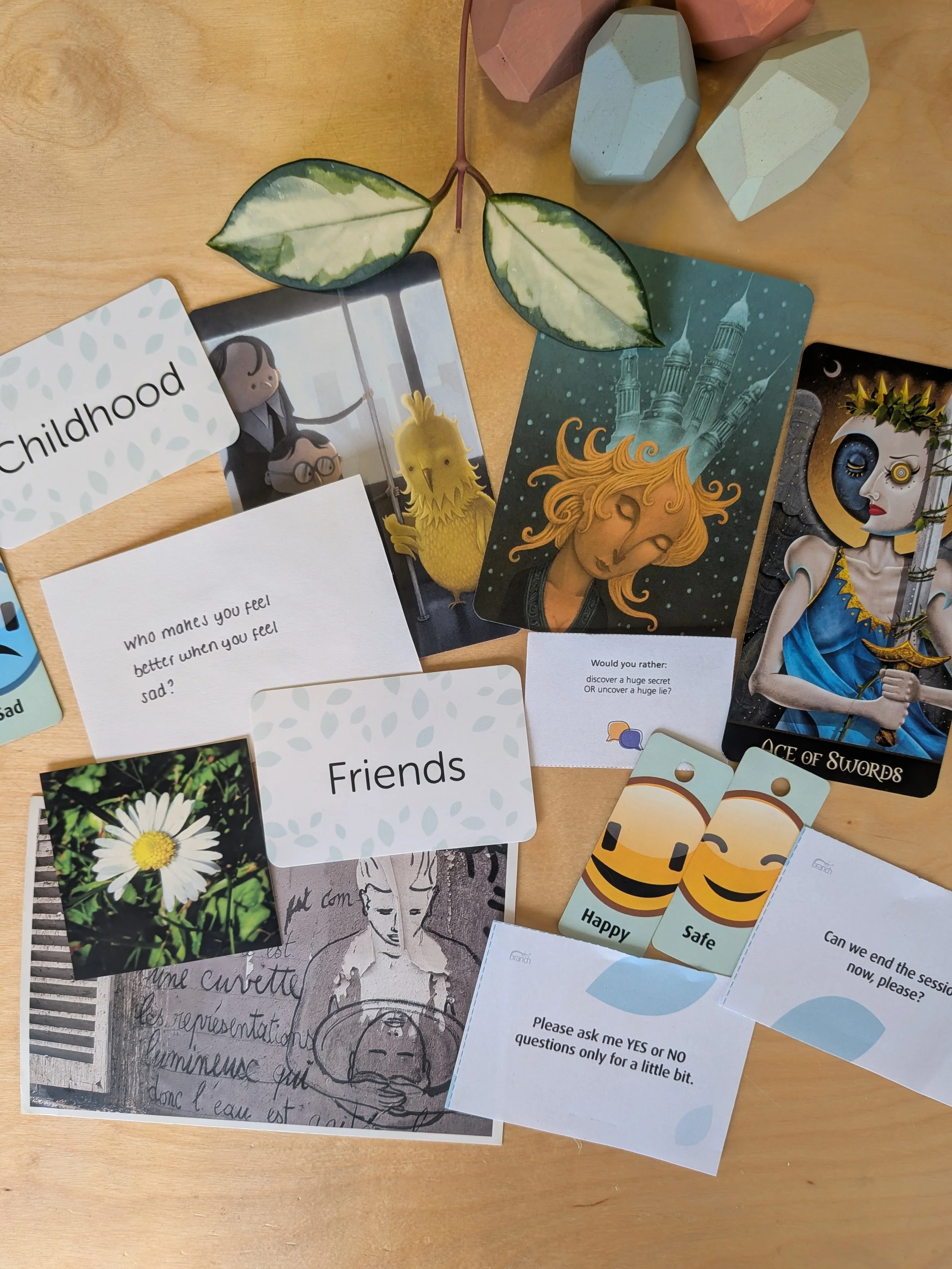
Dixit cards: Originally designed for a storytelling board game, these abstract, surrealist expansion packs are incredible standalone tools for metaphor and narrative processing.
Emotion Cards: Excellent for emotional literacy. You can grab [my printable version here], or more sturdy cards, and plenty of other options elsewhere.
Photo Cards: Highly evocative for grounding and association. [Find my custom set here] or create your own curated stack.
Communication & Values Cards: Amazing for the assessment process and life mapping.
Life Area Decks: Helpful for mapping out lifestyle balance, goals, or stuck points
Conversation Starters: Great for building initial rapport; I enjoy these. For younger clients, light-hearted options like “Would You Rather?” decks lower anxiety quickly.
Archetype & Tarot Cards: A rich source of unique, symbolic art. I particularly love the look of this pride themed Tarot deck. When demystified, Tarot provides a mirror for universal themes.
Mindfulness, Journaling, & Art Decks: Plentiful across the market - examples here, here, here and here.
Words aren’t always enough
Sometimes words keep us in a very cognitive, academic space, bypassing the emotions. Images, art and even emoticons interrupt thought and move us to a more intuitive and emotional state.
Clients begin to think in a different way, projecting their world into the images or map they are creating. It becomes bigger than one card. Cards become important in how they are layered, moved and manipulated.
Stories, concepts and narratives move from a nebulous internal space and become externalised and easier to process and challenge -narrative framing.
Images and words shift as the meaning exists in the viewer’s perception, not on the card - Judy Weiser’s PhotoTherapy Principles.
Art and photo cards can offer safe access into the creative world, which for most adults has been shut off since art lessons at school. This gateway may stay in cards, but it may lead to their own creative expression and play- how exciting.
Finding a Safe Language
Sam had struggled to speak before and had hinted at a difficult home life. In Sam’s world, words had historically felt weaponised, used for formal disclosures, police involvement, and social services investigations. The siblings had been taught that talking was dangerous and what happened at home stayed at home. This made talking therapy somewhat of a challenge. Sam wanted to share but not with words that led to dangerous form-filling. They started with some emotions cards, Sam checking in as shoulders dropped, tension left the room and a relationship developed. The cards dispelled the danger and gave Sam a platform they could trust. Eventually, more cards were brought in, and I began to see a young person who ran deep, who was starting to explore an identity outside of both their family unit and friend group. Images of lights in the dark, glimmers of hope, colour and warmth, which bring a spark of delight to me as well as Sam. The disclosures were important, but they were being investigated with other professionals; in the cards, Sam found a safe space to explore themselves as an individual.
The Spectrum of Decks
Creating Safety in the Therapy Room
Whilst there are no strict rules for using cards as their application is far reaching there are some guidelines to hold in mind for safe use.
Resist interpreting a card for a client. The Golden Rule: Ask “What does this evoke for you?” instead of “This card seems to represents your anxiety.”
Discuss how many cards a client may want to explore, while some will revel in shuffling through a full 78-card deck on the table, other may benefit from a more curated sets to prevent decision paralysis and overwhelmed. With large packs, such as Dixit cards it can help to split them into smaller sets.
Visual images can evoke strong and unexpected emotive responses, it can be helpful to be mindful of a client’s window of tolerance. Establish upfront that clients have control; they can turn cards face-down at any time, put a pack away and end the work. Sometimes when a card has a lot of power it can be useful to think about creative strategies - the counsellor taking responsibility for the card, the card being torn up, hidden away, covered up and so on.
Tarot cards often have a powerful and unique imagery which is great, however it is important to clearly define boundaries beforehand to avoid promoting magical thinking or causing spiritual distress in some clients. These are not appropriate for all clients.
Closing thoughts:
Cards aren’t a gimmick, they are a flexible language for things we don’t yet have the words to say, and a way to externalise and experiment with narratives in a tangible way.
Please share your favourite decks and the way you use them in your work, I am always looking to build on the tools I have. If you haven’t incorporated cards into your work yet, which do you feel drawn to try.
It’s lovely to share a few quiet moments with you today.
Until next time,
💛🌿 Helen
About the Author: Helen Gifford is a counsellor, supervisor, and author of ‘A Practical Guide For Working Therapeutically with Teenagers and Young Adults’.
Support this work: 📕 Order the Book: A Practical Guide for Working Therapeutically with Teenagers and Young Adults ☕ Buy me a toasted teacake: Ko-fi 🌿 Work with me: Clinical Supervision and Training via www.branchcounselling.co.uk
Author Note & Transparency: All case studies or stories are fully fictitious to illustrate the experiences many professionals face; no confidentiality has been broken. I recommend resources based on a combination of clinical experience and consideration of available evidence. These are offered for interest only and are not endorsements of scientific efficacy or clinical recommendations. Please apply your own critical judgment.