
Pause for Success
Why We Need to Help Clients Hold Their Wins
In the UK, we are not just humble; we practice the fine art of self-deprecation. We’re culturally trained from an early age to play down our successes, deflect compliments, and treat major achievements as minor details. “Oh, it was nothing,” or “I just got lucky,” are the default responses. Even style compliments are dismissed: “Oh, this old thing” or “ooo I just got it in the sale” The only permissible brag is to declare a skirt or dress has pockets.

A simple line illustration of a person happily using the pockets in their skirt.
To be described as a ‘bragger’ or ‘show off’ is a true insult
While modesty might play well socially, and these expected responses act as a social script, in therapeutic work it presents a real headache.
As therapists, we know that clients will happily dissect their mistakes under a microscope for an hour. Evolutionary psychology explains this as our brains being hardwired with a negativity bias to spot threats and avoid past pitfalls. However, this isn’t strictly true; more recent research challenges this assumption, moving thinking from hard-wiring to neuroplasticity.
Dismissing our progress means we miss the reward for our hard work, we also dismiss the motivation for continuing our journey. We lose all the valuable insight that comes with it; if it works, then we should build on it!
Success breeds success. When people understand what went right, they can recreate it, build on it, and, quite simply, make more happy. Research into motivation, like Teresa Amabile’s work at Harvard on the Progress Principle, confirms that making small, recognised progress in meaningful work is the single biggest driver of positive emotion and sustained effort.
Yet, clients walk into our rooms every day and treat their progress like background noise.
Our job is to catch the “throwaway victory” before it gets swallowed by the next anxiety on their list. This can take some keen observation!
Client: “And so yeah, I haven’t lost my temper with the kids in six weeks, which is nice, but I’m really annoyed that I still haven’t started that course and I’m thinking it’s because I’m lazy...”
Therapist: “Whoa! Hang on a second. You haven’t lost your temper in six weeks?”
Client: “Erm, no...”
Therapist: “Don’t you think that is worth pausing to celebrate? That was the main goal you arrived at therapy with. That’s great, what have you noticed?”
Client: “Oh, everything is calmer; the house has a completely different vibe. Because the negative spiral we talked about has stopped, actually the kids are less difficult to begin with! My husband said he really noticed the difference; we’re even more affectionate with each other now. I didn’t realise how much we had lost each other in parenting.” (tears up)
Therapist: “Wow. That work has really been worth it. Well done, what a success.”
Client: (looks up quickly) “Well, it’s thanks to you. You did it.”
This is such a classic response in the counselling room. It is discomfort with holding success in action. It’s not ours to own, but we also shouldn’t mirror their deflection by dismissing their gratitude outright.
Therapist: (doffs an imaginary cap) “The work was all yours - I was just a guide.”
Client: (laughs) “It is good.”
Therapist: “Are there any roadblocks that might impact the progress you’ve made?”
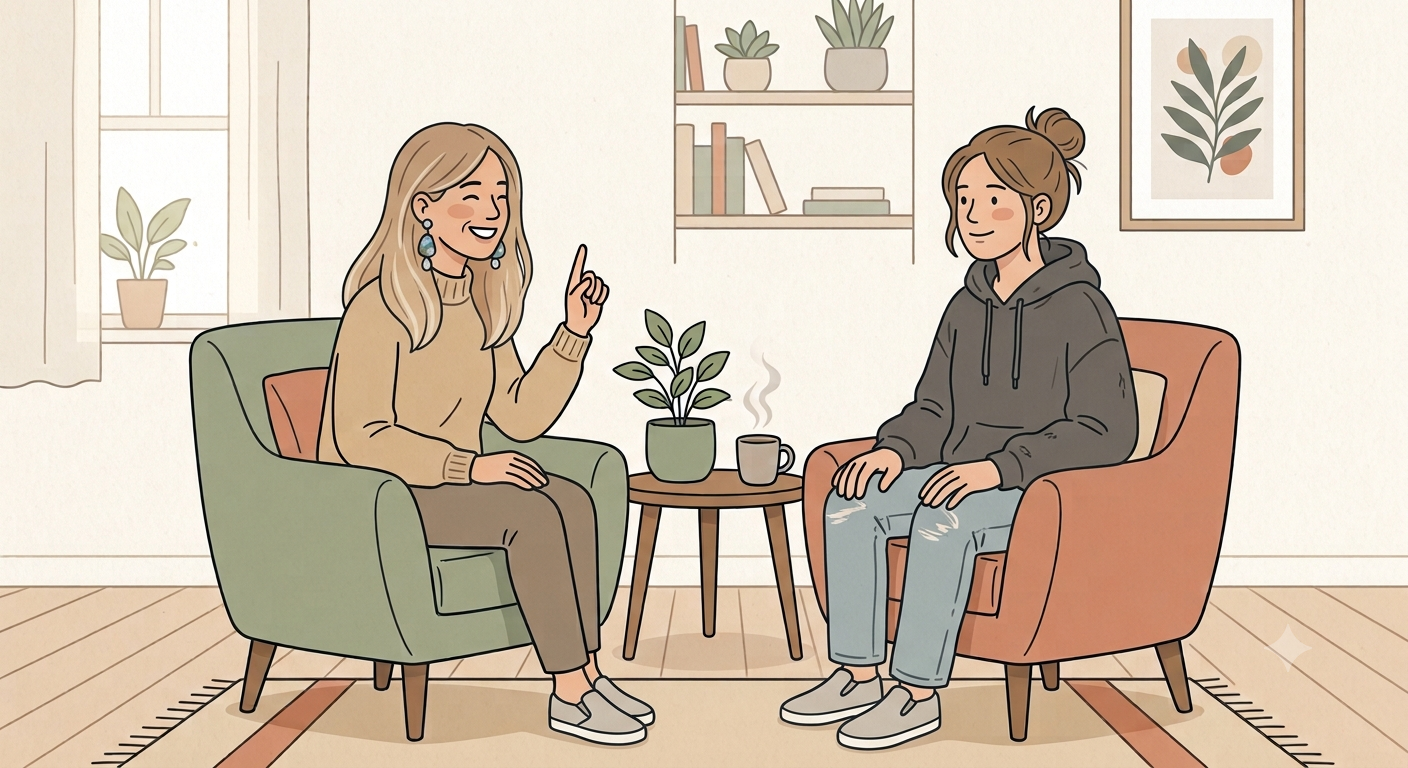
A simple line illustration showing a client and counsellor in a moment of celebration together.
What Just Happened in That Room?
By enforcing that pause, the therapist and client didn’t just give each other a quick pat on the back. We did three therapeutic jobs:
Unpacked the Ripple Effect: Pausing allowed the client to see that her behavioural shift didn’t just stop her shouting; it transformed her home’s climate and relationships, softened her kids’ behaviour, and brought intimacy back into her marriage.
Reflected Agency: When she tried to give the win away to the therapist, the gentle reframing (“I was just a guide”) supported her in internalising her own competence.
Future-Proofed the Growth: Exploring potential roadblocks from a position of strength and accomplishment is infinitely more effective than trying to problem-solve mid-crisis.
Modelling Joy in the Room
This isn’t just for the big successes either. When working with young people, this same principle plays out across a Jenga tower, a game of Connect 4, or my favourite ‘Chairs’. Joining in the unreserved joy of a small win, without qualifying it or being sheepish about it, models healthy, unashamed pride in progress.
And let’s be completely honest: sitting in these moments is wonderfully selfish for us, too.
Therapeutic work is demanding, and burnout is real. Allowing ourselves to pause, inhabit the joy of a client’s journey, and celebrate how far they’ve come isn’t just good clinical practice; it’s one of the greatest privileges of the job. Winning Jenga is good too.
A simple line illustration showing a jenga tower falling.
We often are not great at doing this ourselves - we are likely also raised in the same self-deprecating culture, and we are taught to pass all ‘good work’ back to our clients (rightly so), however, we can’t always live vicariously through their progress.
You did provide a safe space, created a trusting relationship, offered the right challenges, held difficult emotions, managed a client load alongside home life... Finally writing that article, taking time to play with paint - just me?
Take a moment to reflect on your wins this week - actually do it this time - what are they?
It’s lovely to share a few quiet moments with you today.
Until next time,
💛🌿 Helen
About the Author: Helen Gifford is a counsellor, supervisor, and author of ‘A Practical Guide For Working Therapeutically with Teenagers and Young Adults’.
Support this work: 📕 Order the Book: A Practical Guide for Working Therapeutically with Teenagers and Young Adults ☕ Buy me a toasted teacake: Ko-fi 🌿 Work with me: Clinical Supervision and Training via www.branchcounselling.co.uk
Author Note & Transparency: All case studies or stories are fully fictitious to illustrate the experiences many professionals face; no confidentiality has been broken. I recommend resources based on a combination of clinical experience and consideration of available evidence. These are offered for interest only and are not endorsements of scientific efficacy or clinical recommendations. Please apply your own critical judgment.