
The Death of the Map: Why Life Doesn't Look Like the Brochure
Alex is 25 and disillusioned. Tiegan is 25 and broke. Why our therapeutic 'life stages' aren't mapping out for a generation of young adults.
Alex and Tiegan both referred in at the same time, emails arriving one day after another. Both twenty-five. Both scheduled for this afternoon.
As I read their referral info over my jacket potato lunch (tuna and cheese), I thought: Ah, the post-uni wobble. That moment where the scaffolding of formal education is suddenly pulled away, leaving you standing on the shaky ground of “the rest of your life.” But as the afternoon progressed and their stories unfolded, it became clear that this wasn’t just a standard developmental dip. It was a challenge to the rigid societal map of development I was holding in mind.
Two Sides of the Same Coin
Alex is living in the “COVID Shadow.” He “missed” university, even though he technically graduated (just). He didn’t attend the online lectures; he sat in a bedroom in a chilly house-share, avoiding his family, disillusioned, smoking a lot of weed to dull the boredom. He’d never really wanted to go anyway; it was just the expected path, the one that kept him from “failing” his parents. He’d spent his life following default options; he didn’t truly choose. Now, at twenty-five, he’s just seen a careers advisor (booked by his frustrated parents) and, in the questioning, realised with a jolt of terror that he doesn’t actually know what he likes, what he wants, or even who he is. For Alex, the “vibrancy” of the twenties he expected (partially fueled by watching New Girl) is actually an empty vacuum. It feels like I have a 14-year-old boy in front of me, figuring out who he is, uncertain which GCSE options he’s going for.
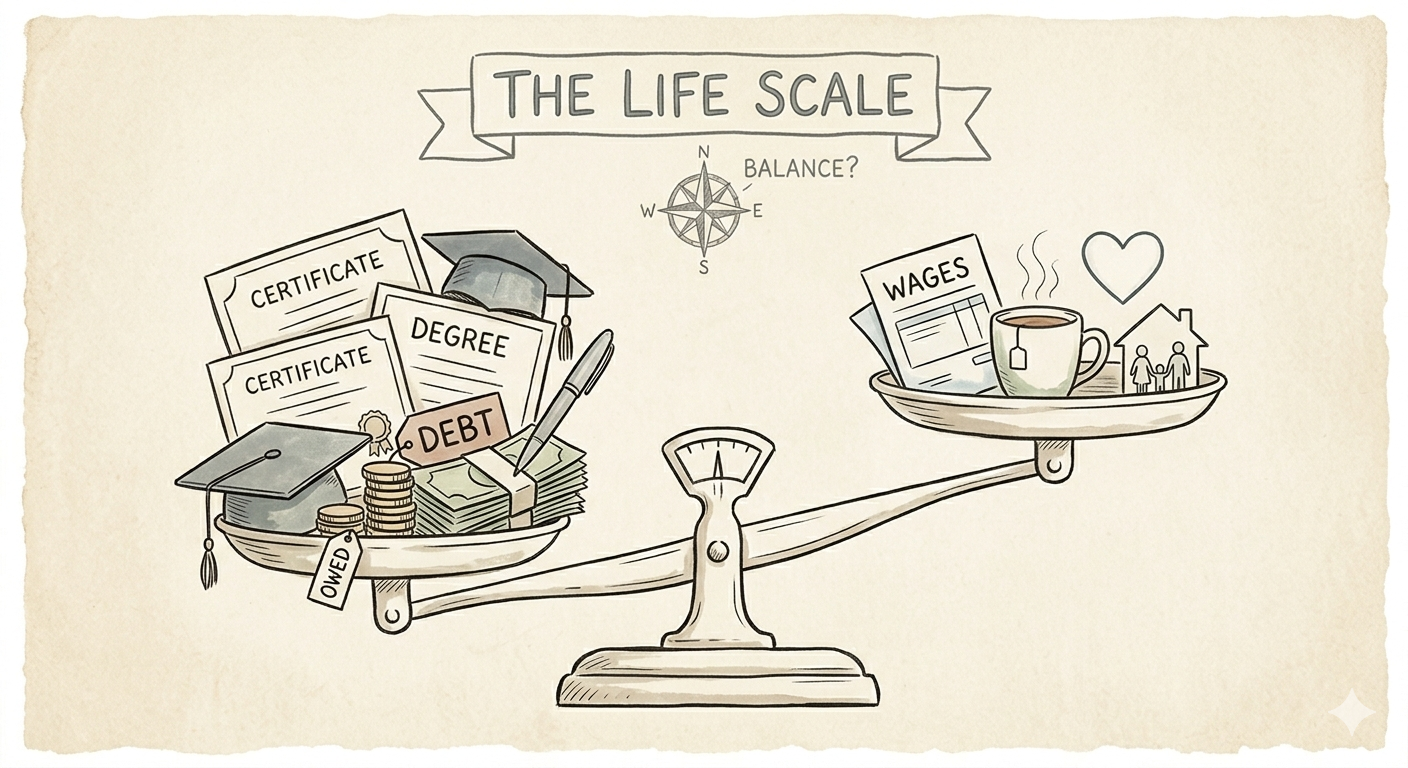
Tiegan, however, is the “Gold Star” student. They have a First, they’re working on completing their Master’s, and their charity work is deeply fulfilling. On the surface, Tiegan is “winning.” But the math of 2026 doesn’t add up. The charity funding doesn’t cover the bills, and the looming academic debt is building in their wake. They got here with almost no support, and their family, based elsewhere and deeply unappreciative of Tiegan’s arty, non-binary, alternative life, is not a safety net. Tiegan is ready for the “adult” milestones: children, a home filled with bright artwork, and a joyous life. But they are trapped in a student’s beans-on-toast lifestyle by an economic crisis. They have the authenticity they crave, but no stability to anchor it. I’m simultaneously jealous and slightly intimidated by Tiegan’s achievements and self-expression, but I'm also feeling the anxiety and frustration of someone who feels trapped.
The Framework: A Guide or a Judgement?
We often look at the decades of life as a series of neat rooms we move through. This framework provides a sense of “order” that can be deeply reassuring, unless you find yourself locked out of the room you’re supposed to be in.
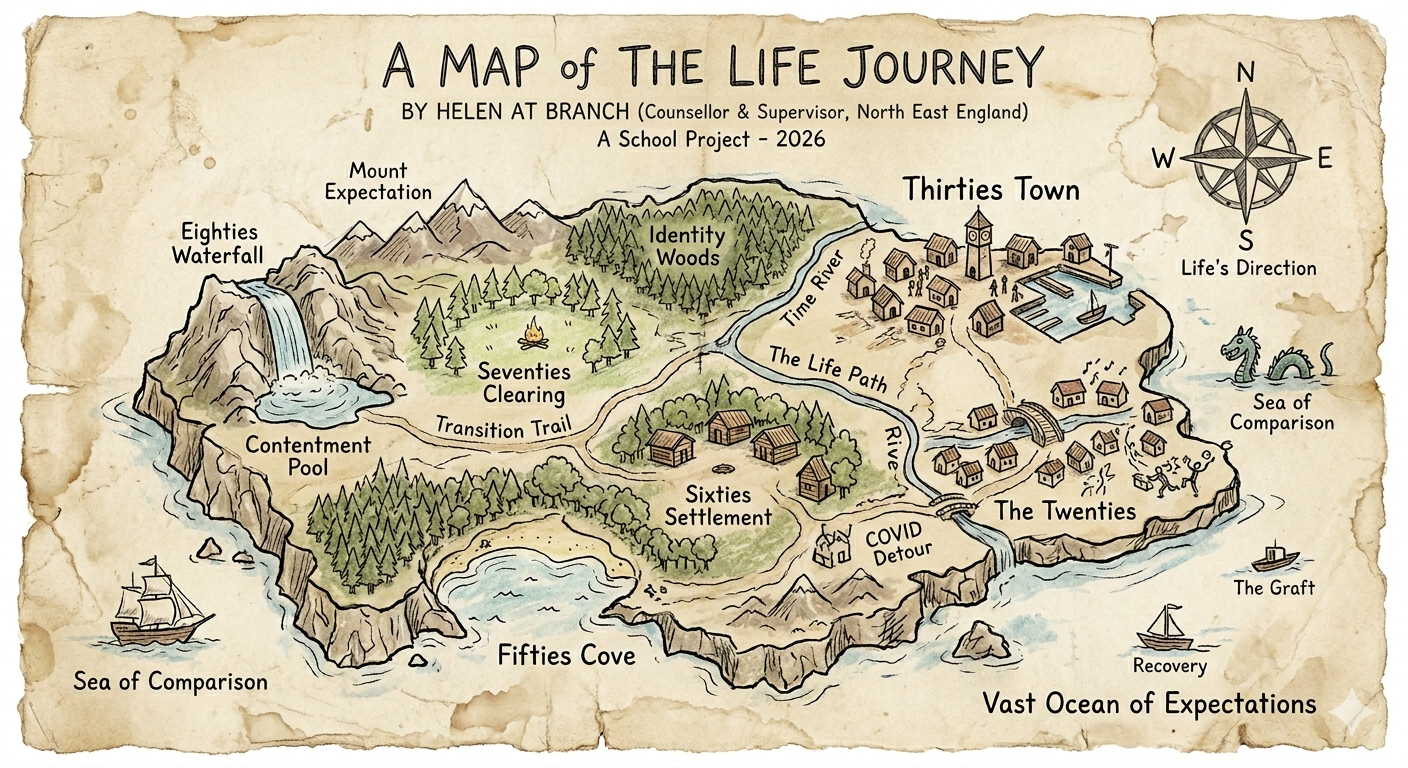
The Early Years: Depending on family circumstances, these are the foundation. They can be a time of play, exploration, and growth, or a different kind of development altogether, one fueled by survival, coping, and the reactions of a nervous system trying to stay safe.
The Teens: Marked by the containers of home and school. Ideally, it’s a time for taking “fun” risks and playing with identity. But for many, it’s a wary time of avoiding risks, playing it safe, or quietly planning an escape from environments that don’t fit.
The Twenties: Societally, this is “The Decade of Energy.” Career starts, travel, new families, vibrancy. But currently, for many, it’s a decade of “The Graft.” It’s surviving in a job rather than a career, feeling “behind” an invisible clock, and navigating the fallout of a world that paused for two years during their formative social development.
The Thirties: Traditionally, the time for “Building Foundations.” But how do you build when the soil is shifting? Milestone Anxiety is at an all-time high here.
The Forties and Fifties: These often bring a welcome shift, reflections, refinements, and the freedom of “giving significantly fewer fucks” about comparison, but the freedom of caring less can only come with a stable foundation.
The Sixties and Seventies: Much like the teens, this is a time of exploration and a return to the question of identity. If the career is gone, who am I? If I am no longer a “teacher” or a “manager,” what is left? Discovering a new sense of self can be exciting or terrifying.
The Eighties and Nineties: These are the Sundays of life. There is rest, contentment, and a “lessening of the bending” we do for others. It is a time for reflection on the past and a deep, quiet focus on the moment.
The Glitch in the System
As practitioners, we have to recognise that this framework is increasingly “glitching.”
COVID didn’t just delay people; it fundamentally altered the developmental “stages” for a whole cohort. When relationships break down, when illness forces a “strong pause,” or when poverty and systemic strife enter the room, the framework shatters.
Privilege is the invisible variable in these stories I shared here. Money offers the stability to take the risks that “exploration” requires. It allows you to fail and try again. Without it, obligation and expectation become a noose that strangles choice. For someone like Tiegan, the “linear path” is blocked by a lack of capital; for Alex, the path was a treadmill he couldn’t get off.
For those of us working therapeutically, this means holding our frameworks loosely. We can’t make assumptions about whether these “milestones” apply to our clients anymore.
When we sit with a “stuck” twenty-five-year-old, our job isn’t to judge them against a map drawn in the 1990s. We need the awareness to acknowledge that the map might be wrong, not the client. We are working in a time where “adulthood” is being redefined in real-time. Our role is to help them navigate the woods they are actually in, rather than pointing at a path that no longer exists.
Practitioner Notes
Emerging Adulthood: Clinically, Alex is a textbook example of “prolonged adolescence” exacerbated by COVID. Research from The Prince’s Trust (2024-2025) highlights that career confidence in 25-year-olds is at its lowest since the 1980s.
The Queer Wage Gap/Tax: Tiegan’s situation reflects what sociologists call the “Queer Tax”, the financial hit taken by LGBTQ+ individuals who lack familial financial support or who are excluded from traditional inheritance/safety nets due to their identity.
Contentious Point: While some practitioners focus on “re-parenting” or “fixing” the delay in Alex’s development, an additional, more contemporary approach suggests that his “stuckness” is a rational response to a collapsed social contract. We should be careful not to pathologise what is actually a systemic issue. And as always, both can be true!
Economic Reality: The gap between “Arty/Charity” work and the cost of living is particularly stark. As above, acknowledging the local economic landscape is vital for practitioners who might otherwise see Tiegan’s “failure to launch” into homeownership as a psychological block rather than a financial one.
In the 2025 UCAS cycle, the higher education entry rate for UK 18-year-olds was 36.3%. It made for a good side-by-side case study example to have both Alex and Tiegan attend university, but I am very aware that this is not everyone’s journey.
It’s lovely to share a few quiet moments with you today.
Until next time,
💛🌿 Helen
About the Author: Helen Gifford is a counsellor, supervisor, and author of ‘A Practical Guide For Working Therapeutically with Teenagers and Young Adults’.
Support this work: 📕 Order the Book: A Practical Guide for Working Therapeutically with Teenagers and Young Adults ☕ Buy me a toasted teacake: Ko-fi 🌿 Work with me: Clinical Supervision and Training via www.branchcounselling.co.uk
Author Note & Transparency: All case studies or stories are fully fictitious to illustrate the experiences many professionals face; no confidentiality has been broken. I recommend resources based on a combination of clinical experience and consideration of available evidence. These are offered for interest only and are not endorsements of scientific efficacy or clinical recommendations. Please apply your own critical judgment.
References:
The Prince’s Trust (2024). NatWest Youth Index: 15th Anniversary Report.
UCAS (2025). 2025 End of Cycle Data Resources: Entry Rates.