
Sick But Not Sick Enough: The Invisible Gap in Therapeutic Care
Please note that this article contains themes of suicide and eating disorders as well as navigating difficult systems; please take care.
Keisha sat silently sobbing, lines cutting through her carefully applied foundation, knees and elbows prominent, even through her school uniform. She was in school even though she’d been sent home at 2 am from A&E after an attempted paracetamol overdose. Nurses had thrown sideways glances and tutted at her, and there were muttered mentions of ‘time wasting’ and ‘attention seeking’. The psych assessment Doctor had spoken in a caring, soft voice but reiterated how good it was that Keisha attended school and how she had lovely piercings, noting on the form ‘takes care of appearance; positive self-care actions’. Keisha was humiliated, believing she was wasting time, and kept her answers short so the Dr could move on to more needy patients. But then, as she was released home with the nod from her mum, “eee a good cup of tea is what you both need and some sleep; everything will look better in the morning,” she realised that she was just returning to her life, the one she had been trying to leave.

An AI-generated illustration of a tearful young person, mascara streaks down their face.
Her counsellor was incredibly concerned. Keisha was a bubbly, petite and caring 15-year-old. She had been referred by her social worker. Her grades had dropped, and there had been some concerns about how her parents were managing with the large, boisterous family on a low income. As sessions had developed, the bubbly mask had dropped, the giggly responses became subdued, and the reality of what Keisha was feeling came to the surface. It was clear Keisha put on the mask to make others’ lives easy; she helped at home, she supported her friends, ‘never a bother’. Mark was sure that Keisha had an eating disorder, with strong cognitive distortions around food and her body; he had raised a concern and asked her Mum to take her to the GP, who had weighed her and said she didn’t reach the parameters for referral. Then he had spoken to the social worker who sighed with a tired smile and suggested ‘a hot chocolate and a slice of cake on the way home might help’, well-meaning, but too overwhelmed to see the severity of what was unfolding.
Every week across therapy rooms, a familiar scene plays out. A client seeks therapy for mild-to-moderate anxiety, burnout, or work stress. The intake assessment indicates a manageable presentation within the therapist’s scope.
Yet, as trust and the therapeutic alliance form and the layers peel back over sessions three, four and five, a far more complex picture emerges: unprocessed complex trauma, chronic suicidal ideation, severe emotional dysregulation with all the negative coping strategies that may come with that; disordered eating, self-harm, addiction.
In a well-resourced system, and what we are taught in training, the ethical path is clear: assess, contain, and refer on to specialist or secondary care services. But today, with community mental health services and specialist charities closing due to lost funding and secondary NHS thresholds sky-high and narrow, therapists turn to the referral landscape only to find locked doors and endless waiting lists. The client, and the therapist, are left stranded in the middle - sick, but not “sick enough”, capable but not capable enough.
The Dilemma for the Private Practitioner
This is hard for all practitioners across the board, but especially for therapists in private practice; this systemic failure creates an isolating and scary, severe ethical and emotional dilemma.
Do we refer and signpost to an 18-month-plus waiting list and close the work knowing the client is unsupported?
Or continue working with the client outside our remit and comfort?
The Duty of Care Trap: Ethical frameworks (BACP, UKCP, NCPS) rightly state working within our competence and refer clients when their needs exceed our capacity. But what happens when “referring on” means discharging a vulnerable person into a scary void?
Unsupported Risk: Private practitioners typically work as solo practitioners without the multidisciplinary safety net (psychiatrists, crisis teams, social workers) that complex cases usually require.
Burnout: Therapists are naturally compassionate. I am sure we are all natural rescuers. BUT this means the instinct to keep holding a client because “no one else is there for them” often leads to vicarious trauma, professional burnout, and messy, blurred boundaries.
How Do We Work Within Our Capacity?
Although we may want to, we cannot fix a broken health system single-handedly, so how do we ethically manage clients trapped in this gap without burning out or operating dangerously beyond our scope? I am afraid there is no good answer here; all cases are different, but there are some important guidelines to follow:
1. Shift from proactive therapeutic work to stabilisation and safety.
When a client’s complexity outstrips what weekly therapy alone can safely resolve, the therapeutic focus needs to shift.
Focus on a safe therapeutic space, psychoeducation, grounding, distress tolerance, and safety planning rather than deep trauma processing or exploratory work that might destabilise the client further.
Consciously slow down the work. In private practice, going “too deep too fast” without secondary care backup can trigger crisis. There is potentially no other support between sessions. For me personally, this means face-to-face work feels safer - I can assess stress in body language and the ‘feel’ in the room, putting in a pause when ‘ok’ is lost.
2. Establish Explicit Boundary and Crisis Contracting at Intake, and again when the work shifts.
Be transparent from session one about what private practice can and cannot provide.
No 24/7 Crisis Cover: Explicitly state in contracts that private therapy is an outpatient service and cannot offer out-of-hours crisis intervention, even if it’s just a ‘little WhatsApp’. It can be tempting to offer more; this can often cause more harm than good; for the therapeutic alliance, potential sense of rejection when you are not available, and burnout from always being available.
Mandatory GP contact: Agree to make GP contact a standard condition of working with higher-risk clients, ensuring the primary care GP remains aware of the client’s status. This prevents you from being the only professional involved; this is important from a care perspective, but honestly, also for your peace of mind.
Pre-Emptive Safety Plans: Formulate a crisis plan early, explicitly listing external crisis lines (e.g., 111, Samaritans, local crisis team) so the client knows where to turn when distressed outside your session time.
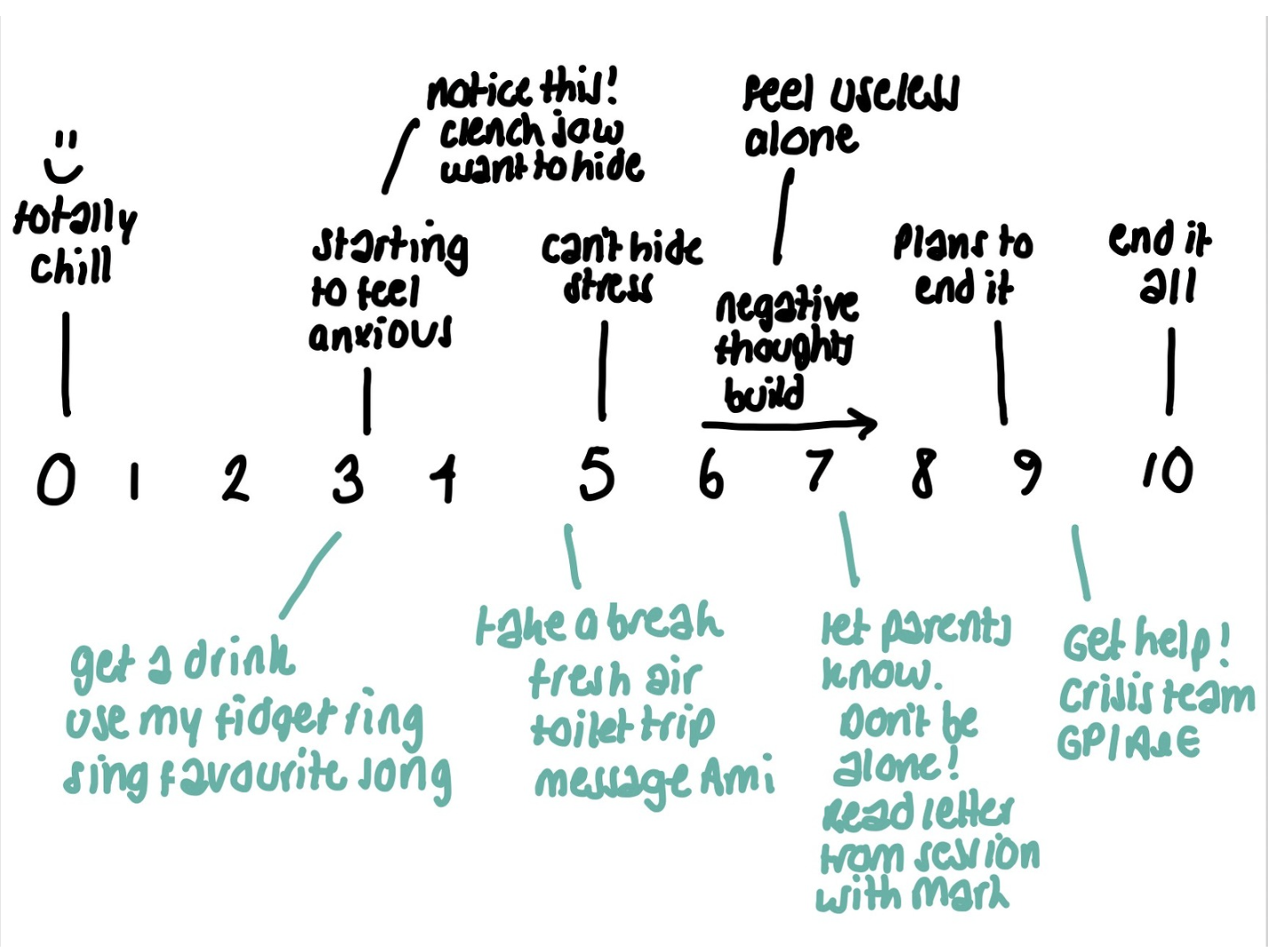
There are many different versions of safety plans and plenty of blank pro formas online; however, I still value a simple 0-10 scale that can be personalised to each individual. It’s easy to create, accessible and very simple to refer to, even in times of distress. This is Keisha’s example.
3. Use Clinical Supervision as a “Capacity Audit”
Supervision is not just for case reviews; it is a safety check for holding boundary lines.
Regularly ask in supervision: “Am I holding this client because it is therapeutic for them, or because I feel scared/guilty about the lack of external options?”
Monitor your signals: Chronic anxiety or dread before a specific client’s session is often a signal that the work has drifted past your capacity. “Is it safe for me to do this work?”
Check that you are ok. Sometimes your supervisor can spot signs of burnout before you do! “Am I ok?”
4. Transparency with the Client
When you realise a client’s needs exceed your capacity, frame the conversation not as a rejection, but as an honest assessment of service safety:
“I care about your well-being, and because of that, I need to be honest about what I can safely support. What you’re experiencing deserves a full multidisciplinary team. While I can offer support, I cannot be your sole safety net or solution. Let’s look at options together...”
5. Resist Systemic Guilt
Therapists remember: You are a practitioner, not the entire healthcare system. Holding a client unsafely beyond your scope out of guilt does not cure systemic underfunding; it merely conceals the gap while putting both you and the client at risk. However, holding a client with honesty and transparency, with the support of your supervisor and the client’s GP, while they are waiting for services can be important work.
Keisha had finally gotten approval for the eating disorder team and was starting treatment Monday; this was her last session with Mark. She looked at him, concerned, “I’m scared”.
Together they reflected on the coping strategies they had explored together and how well she had been able to share her thoughts and feelings with him.
Mark smiled, “You can take all that with you; you have already gathered some tools for your recovery journey.”
If he was honest, he was scared too, but he believed in Keisha, and she needed to believe in herself as well. Sometimes relational hope was the most important therapeutic tool.
It’s lovely to share a few quiet moments with you today.
Until next time,
💛🌿 Helen
About the Author: Helen Gifford is a counsellor, supervisor, and author of ‘A Practical Guide For Working Therapeutically with Teenagers and Young Adults’.
Support this work:
📕 Order the Book: A Practical Guide for Working Therapeutically with Teenagers and Young Adults
☕ Buy me a toasted teacake: Ko-fi 🌿
Work with me: Clinical Supervision and Training via www.branchcounselling.co.uk
Author Note & Transparency: All case studies or stories are fully fictitious to illustrate the experiences many professionals face; no confidentiality has been broken. I recommend resources based on a combination of clinical experience and consideration of available evidence. These are offered for interest only and are not endorsements of scientific efficacy or clinical recommendations. Please apply your own critical judgment.
Clinical notes:
Despite NICE guidelines clearly stating that weight or BMI should never be the sole criterion for an eating disorder referral, GPs on the ground frequently face strict local thresholds that leave early-stage or ‘normal-weight’ eating disorders turned away. This is representative of many mental health referrals at the moment, and if you are seeing this in your practice, I send empathy; please look after yourselves.