
Beyond the £14.99 Subscription: Finding Your True Barometer of Calm
How can we truly work with stress?
The tropes of self-care and poor mental health are everywhere right now. Slide open any social media app or look at any wellness blog, and you’ll find the word stress being thrown around constantly. We are told we need to be mindful of it, learn to manage it, avoid it, minimise it, and ultimately “master“ it.
But this scary beast of ‘stress’ remains entirely intangible.
In a world saturated with talk of cortisol, somatic awareness, adrenaline, and, more recently, the tightening of our fascia - the web of connective tissue that ‘holds’ our physical tension - we have to remember 2 vital points:
None of these biological components acts in isolation.
We all experience stress differently.
While learning about the biological vocabulary is a useful piece of psychoeducation, knowing your own specific signs of stress, as well as your unique signals for calm, is where the real therapeutic work happens.
What even is stress?
Stripped of the marketing jargon, stress is our body’s evolutionary response to a perceived threat or an imbalance between the demands placed on us and our ability to cope. When the brain registers a stressor, it activates the hypothalamic-pituitary-adrenal (HPA) axis, releasing a cascade of adrenaline and cortisol to prepare us for survival.
Because it is a full-body event, generalised lists of symptoms can actually be quite unhelpful. We don’t all react or perceive symptoms the same way. In therapy, we often talk about Dr Dan Siegel’s classic Window of Tolerance model to explain this.
For some, stress pushes them into hyper-arousal - they become hyperactive, buzzy, and intensely distracted.
For others, it triggers hypo-arousal - leaving them feeling listless, unmotivated, and completely flat.
And very often, both can be true for the exact same person at different times.
Mapping the Red and Green Flags
To give you an idea of how messy and contradictory this looks in real life, here is a peek at my own personal dashboard.
My personal red flags of stress:
An overwhelming, sudden irritation at physical mess.
Becoming hyper-vigilant of my physical surroundings.
Zoning out completely (the classic hypo-arousal “freeze” response).
Erratic bursts of energy and frantic productivity.
Endless lists that remain entirely incomplete.
A clenched jaw and twitch, specifically on my right eye.
Walking everywhere at a breakneck speed.
The beginning auras of a migraine.
But identifying the storm is only half the battle. To work through it, we also have to know what the clearing looks like. Over years of working as a counsellor with young adults navigating a ridiculously high-pressure world, I’ve realised that our signs of feeling genuinely rested are just as unique and not something we are always aware of.
My signs of feeling rested:
The rare, quiet ability to fully enjoy a single moment without worrying about the next.
Being able to cleanly compartmentalise worry, rather than letting it bleed into everything.
Immersing myself so deeply in a good book, podcast, or show that the real world is lost for a short while.
Really belly laughing at something that has tickled me.
The sudden urge to write. (Creativity can certainly be born from stress, and it can be a beautiful way to process it. But for me, true, flowing creativity only comes when I’m safely on the other side of it - when perspective and space have returned.)
My routes to calm completely depend on what caused the stress in the first place, what resources are available to me, and what my mind and body are screaming for in that exact moment.
There is no magical tea, supplement, yoga movement, morning routine, or luxury face cream that will “fix” stress. This isn’t to say those things aren’t lovely, comforting, or supportive - they absolutely can be. I have a lovely decaf chai tea, love a child’s pose and a good routine, but stress is nuanced, complex, and deeply human.
And dare I say, it is a naive hope that keeps us wishing we could simply buy the definitive answer for £14.99 on a monthly subscription. True self-care isn’t a transactional purchase; it’s an ongoing, changing internal investigation. It’s the slow, sometimes uncomfortable work of learning to read your own body’s dashboard and responding with what it actually needs - not what a lifestyle brand is trying to sell you.
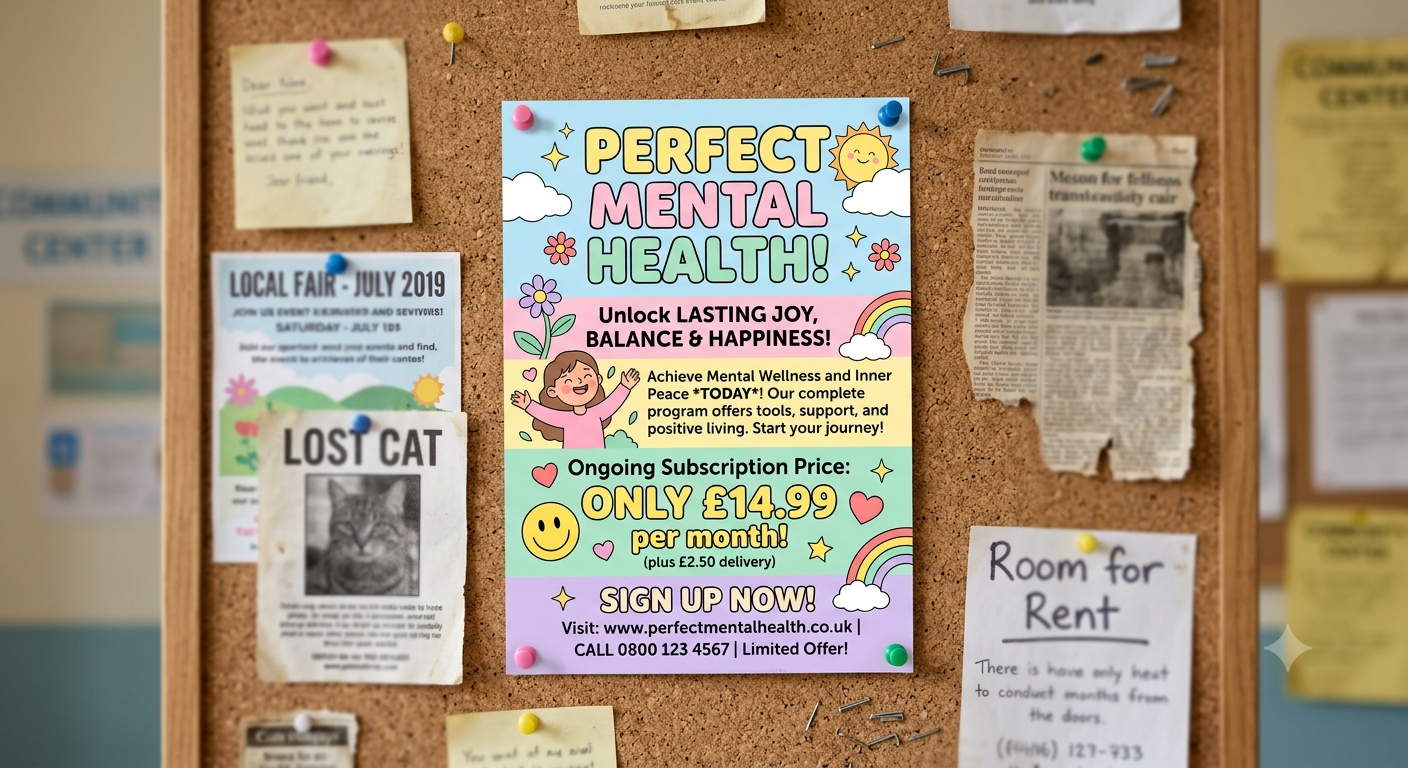
An AI-generated image of a leaflet on a busy notice board. The leaflet offers perfect mental health for an ongoing subscription.
A Moment for Internal Investigation
Before you close this tab and move on with your day, I want to invite you to do a little bit of that dashboard mapping right now. Grab a scrap of paper, or just pause for sixty seconds, and consider these two sides of your coin.
1. Mapping Your Red Flags
Take a moment to think about what your typical stress red flags might be.
Your Body: What do you notice happening inside and out? (Is it a clenched jaw, a racing heart, or a sudden, heavy, flat feeling?)
Your World: How do you feel about your relationships and your immediate environment? Do you become irritated by mess, like me, or hyper-vigilant of the people around you?
Remember: you might notice symptoms that feel completely contradictory, like a burst of frantic energy followed immediately by a total zone-out. That is entirely normal, and having awareness of that flip-flop is a massive win.
An AI generated red flag and green flag.
2. Mapping Your Green Flags
This next part might feel a bit newer to you, but it’s arguably the most important piece of the puzzle. Take time to consider what calm, rested, and regulated actually feels like for you.
The Internal Feeling: How do you know that you are safely back inside your window of tolerance? What does your body feel like when at peace?
The External Impact: How do you interact with the world when you are regulated? What becomes more possible for you when perspective and space return?
Sometimes we need a quick fix; using that breathing exercise, smelling the aromatherapy pulse point roller ball, and dropping into downward dog are all possible and indeed helpful. I am not dismissing these options, but I am suggesting a fuller, clearer picture of the nuances of modern-day stress and calm and how we navigate them.
Learning these coordinates takes time, but it’s the only way to build a version of self-care that actually fits our reality.

The Therapist Bit:
There is a mountain of science behind stress that I’ve intentionally left out of this piece because I want us to focus on how stress feels rather than just how it reads in a textbook. But I am hyper-aware that the same social media traps that target young adults also permeate the therapy world.
As practitioners, we aren’t immune to the urge to offer simple answers for our clients. We are naturally drawn to neat, scientific explanations that feel like a cure-all. The danger is that a single piece of fascinating research suddenly becomes the entire ‘answer,’ rather than just one piece of a massive jigsaw.
Take the recent therapeutic obsession with fascia. Early medicine treated fascia like inert clingfilm wrapping our muscles. Modern histochemical studies completely turned this on its head, proving it contains contractile micro-cells that actively tighten under emotional stress. It’s a brilliant discovery.
However, this has led to bold marketing claims that a therapist’s hands, yoga flow, or a single emotional breakthrough can permanently “release” trauma trapped in our tissues. Biomechanical purists rightly push back here. They point out that we cannot separate tissue tension from the nervous system’s overall tone. Any immediate change we feel after a somatic session is usually neurological - the brain temporarily giving the body permission to drop its guard - rather than a permanent, structural remodelling of the tissue itself.
Working somatically with the body is an incredible tool, particularly for young adults who find it hard to put their distress into words. But it is still just a part of the puzzle. It helps manage the physical echo of stress, but it doesn’t solve the underlying life conditions causing it.

The Science Bit:
I didn’t want to drop some science and run; this would be hypocritical, so here is an overview of the research I explored in my cortisol and fascia fact-checking.
1. The Complexity of the Stress Response, considering cortisol and fascia:
Cortisol and Tissue Degradation: Psychological stress triggers the release of cortisol, which doesn’t just “store” stress but actively disrupts connective tissue remodelling by inhibiting collagen synthesis and accelerating its degradation. This involves impaired immune regulation and oxidative stress, suggesting a systemic physiological shift rather than a localised pocket of “stored” stress. The physical impacts of stress are profound.
Sympathetic Nervous System (SNS) Influence: Fascial stiffness is linked to SNS activation, which influences the expression of cytokines like TGF-β1 that trigger myofibroblast contraction. This means fascial tension is a symptom of a broader autonomic state, implying that treating the tissue without addressing the underlying nervous system activation may only provide temporary relief.
2. The Refutation of Simplistic “Absolutes”
The idea that manual therapy “releases” a specific physical lesion caused by stress is contested by scientific review.
Trigger Point Scepticism: The theory of Myofascial Pain Syndrome (MPS) caused by “trigger points” has been described by some researchers as an invention with no scientific basis. Critics argue that the “vicious cycle” of pain and tension is conjecture and that many clinical outcomes attributed to “releasing” these points may actually be due to contextual effects (placebo), natural history, or counterirritation (using one noxious stimulus to mask another).
Mechanical Limitations: While fascia can actively contract, the forces generated are too weak to directly impact mechanical stability. Instead, these contractions likely influence mechanosensation and neuromuscular coordination. Therefore, the “absolute” claim that manipulation mechanically “realigns” or “releases” the body may oversimplify what is actually a sensory and neurological shift.
3. Manual Therapy as “One Part of the Jigsaw”
Clinical perspectives and research suggest that manual intervention is most effective when integrated into a broader, multi-modal plan.
Treatment Mismatch: In clinical discussions, experts note that relying solely on “releasing” fascia can be a “treatment mismatch,” especially for issues like joint instability where strengthening and neuromuscular control are far more critical.
Multimodal Care: Practitioners who defend Myofascial Release (MFR) often emphasise it as only one part of multimodal care. Relying on a “passive approach” where the therapist “fixes” the patient’s stress through manipulation ignores the necessary active components of recovery, such as movement and exercise.
In summary, the body’s response to stress is a complex intersection of endocrinology (cortisol), neurology (SNS activation), and sensory feedback. Simplistic claims to “eliminate” stress-related tissue issues ignore the contextual and systemic nature of these conditions.
It’s lovely to share a few quiet moments with you today.
Until next time,
💛🌿 Helen
About the Author: Helen Gifford is a counsellor, supervisor, and author of ‘A Practical Guide For Working Therapeutically with Teenagers and Young Adults’.
Support this work: 📕 Order the Book: A Practical Guide for Working Therapeutically with Teenagers and Young Adults ☕ Buy me a toasted teacake: Ko-fi 🌿 Work with me: Clinical Supervision and Training via www.branchcounselling.co.uk
Author Note & Transparency: All case studies or stories are fully fictitious to illustrate the experiences many professionals face; no confidentiality has been broken. I recommend resources based on a combination of clinical experience and consideration of available evidence. These are offered for interest only and are not endorsements of scientific efficacy or clinical recommendations. Please apply your own critical judgment.
References:
Journal Articles
Quintner, J. L., Bove, G. M. and Cohen, M. L. (2015) ‘A critical evaluation of the trigger point phenomenon’, Rheumatology, 54(3), pp. 392–399. doi: 10.1093/rheumatology/keu471.
Schleip, R., Gabbiani, G., Wilke, J., Naylor, I., Hinz, B., Zorn, A., Jäger, H., Breul, R., Schreiner, S. and Klingler, W. (2019) ‘Fascia Is Able to Actively Contract and May Thereby Influence Musculoskeletal Dynamics: A Histochemical and Mechanographic Investigation’, Frontiers in Physiology, 10, p. 336. doi: 10.3389/fphys.2019.00336.
Webpages and Online Forum Discussions
r/physicaltherapy (2023) Thoughts on Myofascial release therapy and its effectiveness?. [Online] Reddit. Available at: https://www.reddit.com/r/physicaltherapy/comments/1puagdq/thoughts_on_myofascial_release_therapy_and_its/ (Accessed: 13 July 2026).