
Now what? - Why More Knowledge Feels Like Less Clarity
Navigating the 'Messy Middle' between 90s grit, modern science, and a support system in crisis.
We know more than ever before. Unless we stop listening or start burning the books, the sheer volume of data we possess about the human brain is at an all-time high.
And yet, it feels like we have less clarity than ever.

A black and white image of a woman looking solemnly at many books.
As a counsellor, I see this daily. We are stuck in the “Messy Middle” of a massive knowledge shift. In research and design, we talk about the Double Diamond: first, we diverge, we go down the rabbit holes, explore the nuances, and expand our understanding of all the possibilities. Then, we converge, we hone that data into specific, actionable solutions and policies.
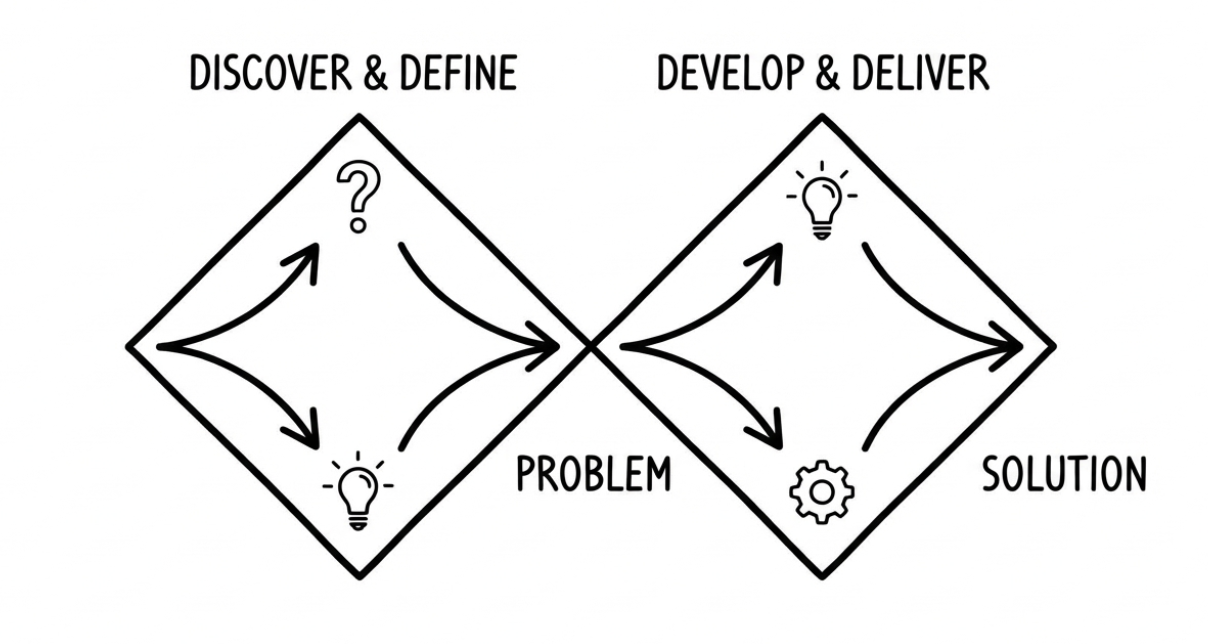
A simple line illustration of the double-diamond design model for divergent and convergent thinking.
For the last 20 years, neurodivergence research has been in a wild, divergent explosion. We’re moving from the cold, limited Medical Model (viewing a person as a “broken” set of symptoms to be fixed) toward the Social Model (viewing the environment as the thing that needs adjustment).
But because we are currently stuck between these two diamonds, lots of people are left behind. This translates across medical support, social support, education, and access to work. We have learnt a vast amount about our differences, but we just haven’t learnt what to do with that information yet.
The Retrofit Problem
The problem is that we are trying to retrofit new understanding into old frameworks. We have “First Pass” thinkers still clinging to 1990s stereotypes: that ADHD is just a “naughty boy” who can’t sit still, or that being Autistic means you’re a human calculator for train timetables.
On the other side, we have the inclusive, passionate advocates who see the nuance, but they are shouting into a void of decimated funding. Awareness is at an all-time high, but systemic support is at an all-time low. The result? You get a diagnosis that seemingly explains your entire life, followed by a “helpful” A5 leaflet and a three-year wait for a follow-up... hang on, what follow-up?
The Resilience Anxiety
This “Messy Middle” has created a profound anxiety for parents and adults, often split along generational lines.
The “Children of the 80s and 90s” were raised on a diet of “Just get on with it” and “Don’t make a fuss.” Did that make us tougher? Undoubtedly. Did it leave many of us with a legacy of masking, burnout, and late-diagnosed trauma? Also, yes.
Now, we see the pendulum swing. We can protect children from difficult environments. We can accommodate sensory needs. This reduces trauma, but it also triggers a terrifying question for parents: “Am I protecting them, or am I limiting them?”
We find ourselves paralysed by the “either/or” of modern neurodiversity:
“Am I masking because I’m conforming, or is this the real me?”
“If I let my child avoid the school yard, am I saving them from a meltdown or stopping them from building the resilience they’ll need as an adult?”
“If a child hits a friend, do they need a sensory break or a consequence?”
I can admit I find myself here regularly. I often need to take a minute to step back and assess what my genuine beliefs are, stripped of the noise.
The Static Trap
The more we learn, the more we realise that neurodivergence isn’t a static set of parameters. It is broad, fluid, and individual, and it shifts for each person over time. But our systems, schools, workplaces, and the government require static boxes. When we try to fit a fluid human into a static policy, the human has to work twice as hard just to access the “support” that is supposed to help them. Currently, the UK system is a “generalisation” designed for a majority that doesn’t exist. It is a framework that only works for those who can mask well enough to pretend they don’t need it. When the system offers a rigid or seemingly contradictory set of instructions, we end up looking for ‘our people’ in vain.
Beyond the Leaflet
If we continue to squeeze new ‘solutions’ out of these old, brittle frameworks, we will stay confused and limited.
We don’t need more “broad advice.” We need a new framework that is Proactive rather than Reactive. This isn’t just about “inclusive” language; it’s about structural change that assumes neurodiversity is the default, not the exception.
I don’t know exactly what this looks like yet. But I know it starts with moving past the “First Pass” labels and the A5 leaflets. It starts with admitting that “one size fits all” is just another way of saying “this fits no one.”

Form filling, complex paperwork. Photo by Kelly Sikkema on Unsplash (edited)
💬 The “Middle Ground” Reflection
We are all navigating this shift in real-time. Whether you are neurodivergent yourself, parenting a neurodivergent child, or supporting someone in your professional life, you likely feel the tug between the “old ways” and the “new understanding.”
This week, I’d love to hear your thoughts in the comments on one (or all) of these questions:
The Internal Dialogue: When you face a challenge, which “voice” speaks loudest? Is it the 90s-style “Just get on with it” or the modern “How can I adjust my environment to feel safe?”
The Support Gap: Have you ever experienced the “A5 Leaflet” moment? That point where you had the clarity of a diagnosis or an insight, but absolutely no systemic framework to actually help you move forward?
Let’s discuss: How do we build “resilience” without it becoming a mask for “trauma”?
It’s lovely to share a few quiet moments with you today.
Until next time,
💛🌿 Helen
A small aside for those who got this far: I am wondering how useful the format of my monthly newsletters is? ‘February’ is still in draft! If you like this type of article, please let me know!
Support my work: 📕 Buy my book ☕ Buy me a virtual toasted teacake or cuppa on Ko-fi 💛
Author Note & Transparency: I recommend resources based on a combination of clinical experience and consideration of available evidence. Any suggestions are offered for interest, not as endorsements of scientific efficacy or clinical recommendations. Please apply your own critical judgment.