
Challenging Aunt Enid: Navigating the Gap Between Bias and Burnout
From the school yard to public policy.
I remember coming across an agitated maths teacher in the corridor, the students hustling down the corridor, hoping to join the toilet queue for the last 2 minutes of break. The teacher leaned against the door frame and sighed, “Year 9 are a nightmare. Every single one of them. They don’t deserve a break-time.” From behind me, a small voice whispered, “But I did nothing wrong”.
We’ve all been there. Whether it was a teacher punishing the whole class for one boy’s backchat, or a manager banning “work from home” because one person was caught watching Netflix on the clock. It’s called Collective Punishment, and as a teenager, it felt like the ultimate betrayal of justice.
But as an adult, and as a counsellor, I’ve realised that collective punishment is just the clumsy end result of a very human habit: The Shortcut.
The Stereotype
We are all guilty of generalisations. Yes, even you, reader.
Our brains are essentially efficiency machines. We process millions of bits of data every second; to keep us from being overwhelmed, we group information. Some of us categorise “big male in a hoodie” as “danger”, so we don’t have to assess every individual hoodie we meet.
This is a “First Pass” of information. It’s a survival mechanism. The problem starts when we allow the First Pass to be our Final Pass.
The “Aunt Enid” Filter
We see this most clearly in the “Aunt Enids” of our lives. You know the type. She “isn’t sure about them gays, because that one in the paper was a wrong-un and it seems a bit shady to her”, and don’t get her started on people with nose-piercings, likely hippies, probably smelly, just like the lass serving in the little Asda.
To Enid, she is just staying safe. She has taken a tiny data point - a “minority of a minority” and stretched it until it covers the whole group.
In psychology, we view this as Confirmation Bias. Once Enid decides that people with piercings are “shady,” her brain will highlight every rude person with a piercing she meets and conveniently “delete” the ten polite ones who showed her which isle the nice strawberry jam is on.
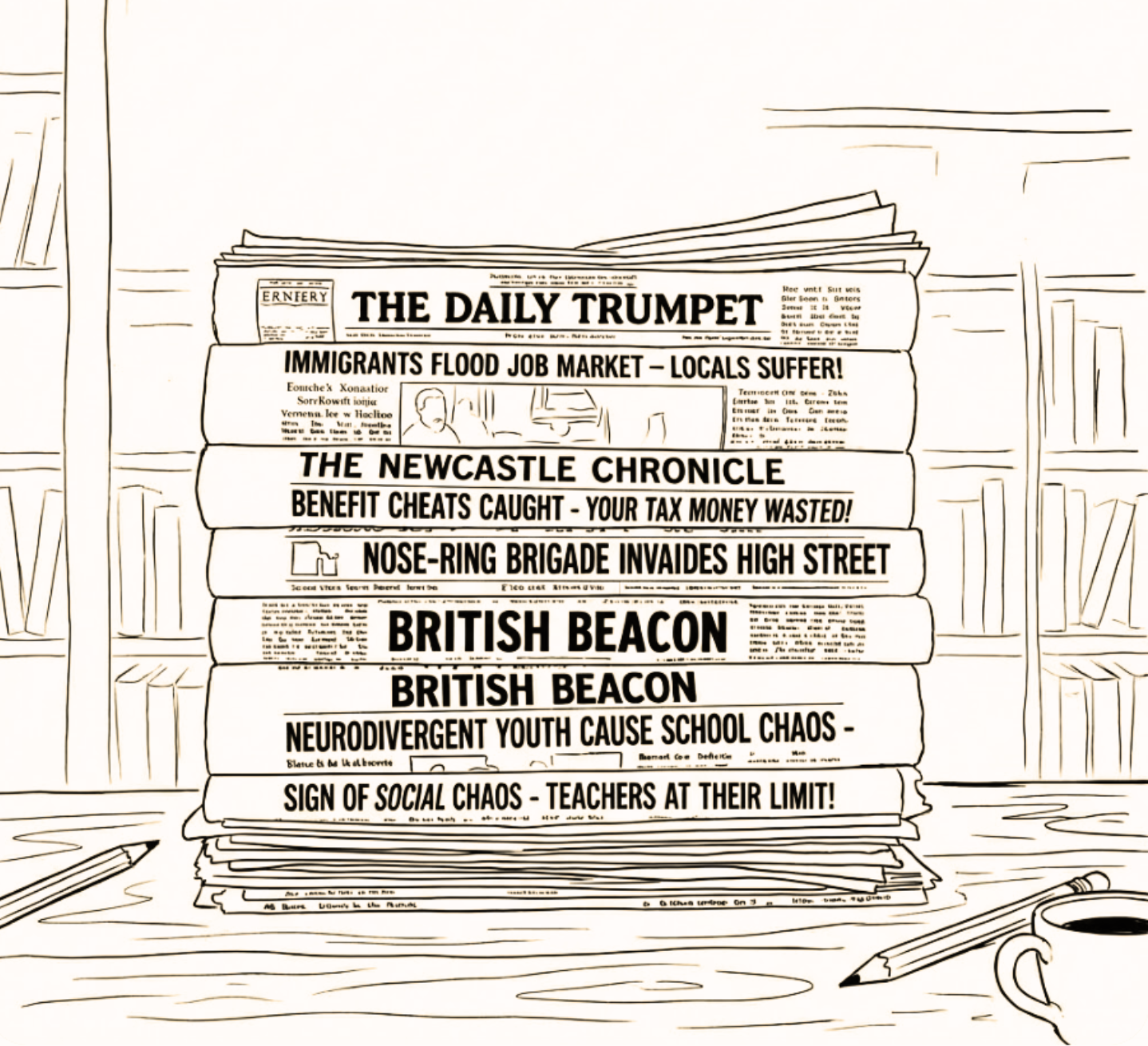
When “Peopling” Becomes Policy
“People will be peopling,” as I like to say (or stole from a true crime podcaster, shh). In any given population - whether we are talking about immigrants, benefit seekers, white middle management, or the neurodivergent community, there will always be a tiny minority that takes advantage. There will always be a “wrong-un.”
This is statistically inevitable. However, we have a profound problem when this “minority of a minority” becomes the driver for National Policy. When we design systems to “catch” the 1% who are cheating, we often end up suffocating the 99% who are just trying to survive. We build “hostile environments” to stop a handful of bad individuals, forgetting that the collateral damage is the vast majority of people who are suffering, working, and contributing.
From Judgment to Curiosity
We need to get better at sifting.
In my work, I try to encourage a move from Judgment to Curiosity.
Judgment says: “This group is impolite and demanding.”
Curiosity asks: “Why is this group acting this way?”
If a group of people is “demanding” food, it isn’t a cultural phenomenon; it seems far more likely a starvation phenomenon. If a group of neurodivergent students is “disruptive,” it isn’t a behaviour issue; it’s likely a sensory-overload issue.
We have to check cause and effect. We have to do some “Respectful Research.” Before we decide “who” a person is based on their “group,” we have to look at the individual sitting in front of us.
The Challenge
The next time you find yourself making a “Final Pass” on a person - whether it’s someone in the news or the person serving you in Asda - try to catch your brain in the act.
Acknowledge the shortcut. Thank your brain for trying to be efficient. And then, do the hard work of being accurate instead.
It’s easy to talk about Aunt Enid, harder to challenge Aunt Enid, but it’s harder again to look at our own “internal Enid.” We all have a part of us that uses shortcuts to save energy.
If you want to move from Judgment to Curiosity, try this three-step reflection exercise.
1. The “First Pass” Audit
Think about a group of people that currently “irks” you. It doesn’t have to be a major political group; it could be “people who use their phone on speaker phone in public places,” (just me?) “cyclists,” or “parents at the school gate.”
Write down the shortcut: What is the one-word label your brain gives them? (e.g., Selfish, Rude, Entitled).
The “Protector” Question: What is your brain trying to protect you from by using this label? (e.g., Disappointment, loss of time, feeling ignored).
2. Evidence audit
The next time you encounter an individual from that group, consciously “pause” the shortcut.
Look for one piece of counter-evidence.
If you think “All cyclists are aggressive,” look for the one who stops at the red light or nods a thank you.
The Goal: You aren’t trying to prove the group is “perfect”; you are just proving to your brain that the “Final Pass” must be more nuanced than the first.
3. The Big Picture - Policy Reflection
Look at a recent news story about a policy change (benefit caps, immigration rules, school uniform crackdowns).
Ask yourself: Is this policy designed for the 99% who need it, or the 1% we are afraid of?
How would that policy look different if it was designed with the “Majority” in mind, with “Adjustments” for the bad actors, rather than the other way around?
💬 Reflective Question:
“Which ‘shortcut’ does your brain take most often to save energy, and what is the one thing that usually helps you see the individual behind the label?”
The “But Also...” (The Grace of the Middle Ground)
There is a flip side to this, and it’s a matter of simple human capacity: the sheer amount of effort accuracy takes.
Most of us no longer live in quiet villages of 150 people. Because our lives are lived in the digital slipstream, we are exposed to thousands of people daily. We are bombarded by a relentless tide of viewpoints, agendas, biases, arguments, and pleas for help.
It is physically and mentally impossible to recognise, assess, research, and determine the “right” response to every single thing that crosses our lives and screens. It often feels like we are trapped in a binary choice: either we put our heart and soul into being an “Informed, Passionate Advocate” for every cause on earth, or we stick our heads in the sand and simply nod along with the majority OR loudest voice to save our sanity.
But there is a middle way. Some shortcuts are not just a sign of a “lazy” brain; sometimes, they are a survival mechanism for a tired one. We are not built to carry the weight of the entire world’s nuance at 9:00 AM on a Thursday.

It is okay to:
Reserve judgment: You don’t need an immediate “take” on every headline.
Defer your research: It is perfectly fine to say, “That looks important, but I don’t have the mental space to look into it properly today.”
Select your focus: You can choose to be deeply informed about one or two things, while letting yourself be “just okay” with the rest.
Curate your trust: Find an advocate or a spokesperson (online or offline) whose ethical compass matches yours, and allow them to help you navigate the noise.
The Power of Three Words: You are allowed to say, “I don’t know.”
We don’t have to choose between being a perfect scholar of the world or a total hermit. Accuracy is a goal, but grace is a necessity.
After all, it’s much better to be a work-in-progress who admits they are learning than a finished product that’s built on a guess.
It’s lovely to share a few quiet moments with you today.
Until next time,
💛🌿 Helen
If you’d like to support my work or are interested in learning more about working therapeutically with young people, you can:
📕
Buy my book ☕ Buy me a virtual toasted teacake or cuppa on Ko-fi 💛