
From TikTok to Street Corners: What Happens If We Unplug Them?
Zara sat with her quilt bundled up around her, tea steaming on the bedside table, laptop on her knees, phone in hand. The room was a hum of low-fi beats from her Google speaker and the soft glow of screens.
She couldn’t believe her GCSEs were this year; the History end-of-topic assessment was tomorrow, and panic had set in. In a moment of blank terror, she had forgotten every detail about food famine. She Snapped a picture of her unfinished Quizlet with a string of sad faces, sharing her nerves with her friends.
Within 60 seconds, her phone pinged. Her friend Maya had sent a TikTok: a teacher breezing through the exact facts she needed, plus a practice question with a model answer. Zara sent a flurry of hearts back, wiggled her toes in delight, and made the changes to her notes. She was going to ace this test.
In the bedroom next door, the atmosphere was different.
Her younger brother, Arlo, was balanced on his desk chair, knees pulled tight to his chest. His laptop was open, but the homework tabs were buried under a YouTuber talking animatedly about server updates for his favourite game. Arlo was trying to focus on the fast-paced excitement, but his eyes kept darting to his phone.
The class group chat was exploding. “mayb hes gay!” “haha yea chubby gay boy” “he;s totally reading this and saying nothing so looks like it’s true ☠️”
A picture popped up next. At first, Arlo squinted, twisting the phone to make sense of it. His body reacted before his brain did; bile rose in his throat as he realised it was a pornographic image, edited to crudely look like him.
Laughing emojis filled the screen. “I’m dead, u r fucking hilarious man.”
The thought of school tomorrow sent a tremor through his body that wouldn’t stop. The homework on quadratic equations didn’t even enter his mind.
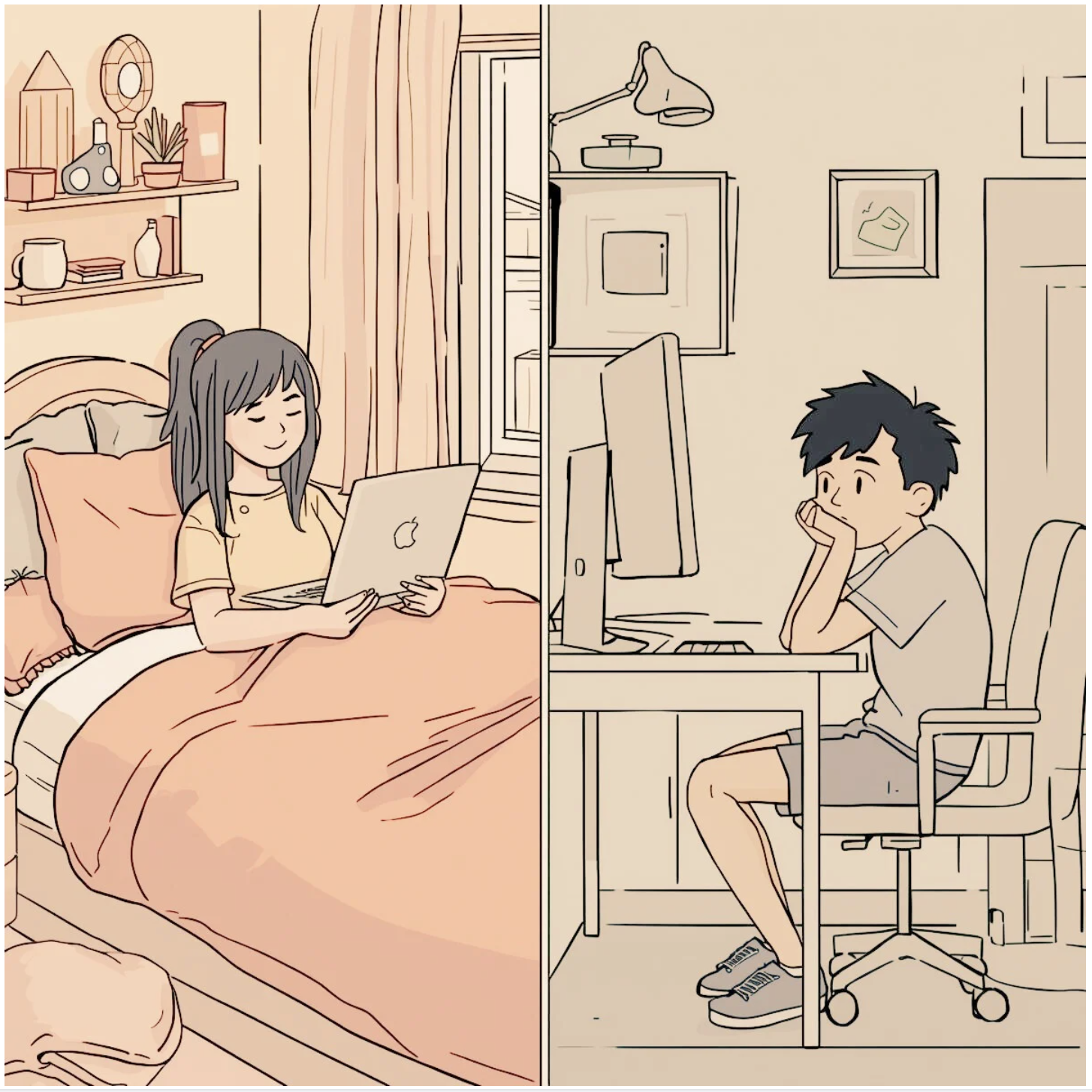
A simple line illustration in muted colours. On the left, a teen girl sits happily on her bed, revising using social media to help. On the right, a young teen boy looks anxiously at his computer screen.
The Debate
Recently, political talk has intensified regarding the UK potentially following Australia’s lead in banning social media for under-16s.
The suggestion has prompted fierce debate. Many are all for it, focusing on the Arlos of the world. They argue that young people are addicted to their devices, exposed to inappropriate content, at risk of grooming, and generally growing up too fast without experiencing “real life.” I can see the draw here. As adults, our instinct is to protect children from an uncontrolled and uncontainable online world.
However, not everyone feels the same way. Ian Russell, who has campaigned tirelessly for online safety after the tragic death of his daughter Molly, has expressed concern that bans can become political theatre rather than genuine care. There is a strong argument that we need to teach young people how to navigate this world, rather than simply excluding them from it, especially when it has become the primary public square of their generation.
Furthermore, there are logistical questions. How is this enforceable? And will it drive vulnerable teens into darker, less regulated corners of the internet?
Where Do I Stand?
Having worked with young people for years, I find myself in the messy middle.
I have written before about how the studies on screen time are rarely conclusive (see my previous post, The Demonisation of Media). The data suggests that how social media is used matters far more than if it is used. We have to consider the type of platform, the nature of the connections, the user’s vulnerability, and whether they have access to support and education.
Zara used her connection for academic support and co-regulation. Arlo was used as a target. A blanket ban removes Zara’s support network but doesn’t necessarily solve the cruelty in Arlo’s peer group; it just moves it to the playground or a gaming lobby.
Education vs. Abstinence
Even if a ban is decided upon, we must remember that prohibition rarely works in isolation. Much like sex, education versus abstinence, simply saying “no” is not enough. We still need to educate in these formative years.
Recent findings about the gender gap in online harm show that less than 50% of parents monitor and limit their child’s online access and experience, or discuss their experiences online. We have to remember “parents are children’s main source of information about online safety and will always play a critical role in children’s online lives.”
All of us need to know how to navigate the digital landscape. We need to teach young people how to disseminate and check information, how to stay safe, how and when to report abuse, and how to assess their own digital wellbeing. We have to admit that there are significant positives alongside the negatives. If we don’t, we risk alienating young people, who will inevitably find a way onto these platforms regardless.
A Natural Shift?
I also believe a natural shift is already happening. As the world is swept by AI and the next leap in tech, I am seeing young people use their devices differently. Many are self-monitoring their social media and instead using the internet to explore crafts, music, art, and nature.
Perhaps, instead of focusing the entire fight on a digital ban, we could put those resources into the physical world. Let’s fund youth groups. Let’s provide free classes in crafts and art. Let’s support Forest Schools, green spaces and create places for young people to come together safely again.
Because if I had to choose between scrolling TikTok in my warm bedroom or hanging out on a cold street corner because there is nowhere else to go, I know what I would pick.
💭 Closing Thought
How does social media play a part in your life or your family’s lives? Can you create a healthier relationship with it? Are you also seeing some shifts in how devices are used?
It’s lovely to share a few quiet moments with you today.
Until next time,
💛🌿 Helen
If you’d like to support my work or are interested in learning more about working therapeutically with young people, you can:
📕
Buy my book ☕ Buy me a virtual toasted teacake or cuppa on Ko-fi 💛
📎 Author Note & Transparency: I recommend resources based on a combination of clinical experience and consideration of available evidence. Any suggestions below are offered for interest, not as endorsements of scientific efficacy or clinical recommendations. Please apply your own critical judgment.