
Supporting overwhelmed people when we are overwhelmed!
As I begin to recover from being unwell and feeling overwhelmed, I’ve had a moment to reflect on how overwhelm impacts us all.
There is a specific kind of quiet or calm that cloaks the therapy room just after the door clicks shut. Outside, the world keeps spinning at its usual frantic pace, full of noise, notifications, and expectations. Sometimes we can still hear it, but inside, there is a hush. But sometimes, we need to talk about the noise.
She sat, letting all the thoughts in her head pour out over the therapy room floor.
“So then I took her home, this tiny, precious baby that I love so intensely, and yet part of me thinks someone else should take her because I have no idea what I am doing. I thought it was the baby blues, but that hasn’t gone away.
It’s just never-ending questions: bottle or breast? Does a dummy cause speech delay? Should I be using more organic products, or is it pretentious to be all organic? At what age should I buy her shoes? Apparently, some damage little feet? When do I get a front-facing car seat? Should she go to nursery for socialising, or does that make me a lazy mum? Should I teach her to behave or to have a voice? If I back down in an argument with my partner, am I teaching her to be subservient? My mum says one thing, the health visitor says another, my partner and the baby books don’t agree, my TikTok and Instagram algorithm don’t even agree!”A big inhale.“I have these thoughts all the time about everything. Every decision feels huge, overwhelming, and paralysing.”
At the same time, an internal monologue runs on a tangent: Is this normal? Maybe I should be talking less. Is the counsellor irritated? Maybe she thinks I’m losing it; maybe I’m overreacting and wasting her time with whining. Is this how counselling is supposed to go? Oh God, maybe I am doing counselling wrong; that must be an absolute failure. I can’t even have a crisis properly. Oh, hang on, she just smiled encouragingly...
The counsellor nods with a soft smile.
Oh, I remember this so clearly. Having a baby is hard enough, without the sheer volume of strong opinions thrown at you. Transitioning from finding your feet as a young adult to suddenly being responsible for a tiny human is a massive shift. It’s not like I was any less stressed back then, and here she is looking to me for support. That’s okay, though; I don’t need to have all the answers or be perfect.
God, you’d think this many years in I wouldn’t still have to reassure myself like that. I wonder if there will ever be a day I feel like a competent professional? Does anyone else feel like a proper professional? I’m pretty sure I’ve got a hole in my left sock. That’s how bloody professional I am. Am I going to remember everything she has said? I don’t understand how some counsellors don’t take notes. Note to self: this time, write them up straight after, and maybe bring the imposter stuff to supervision again.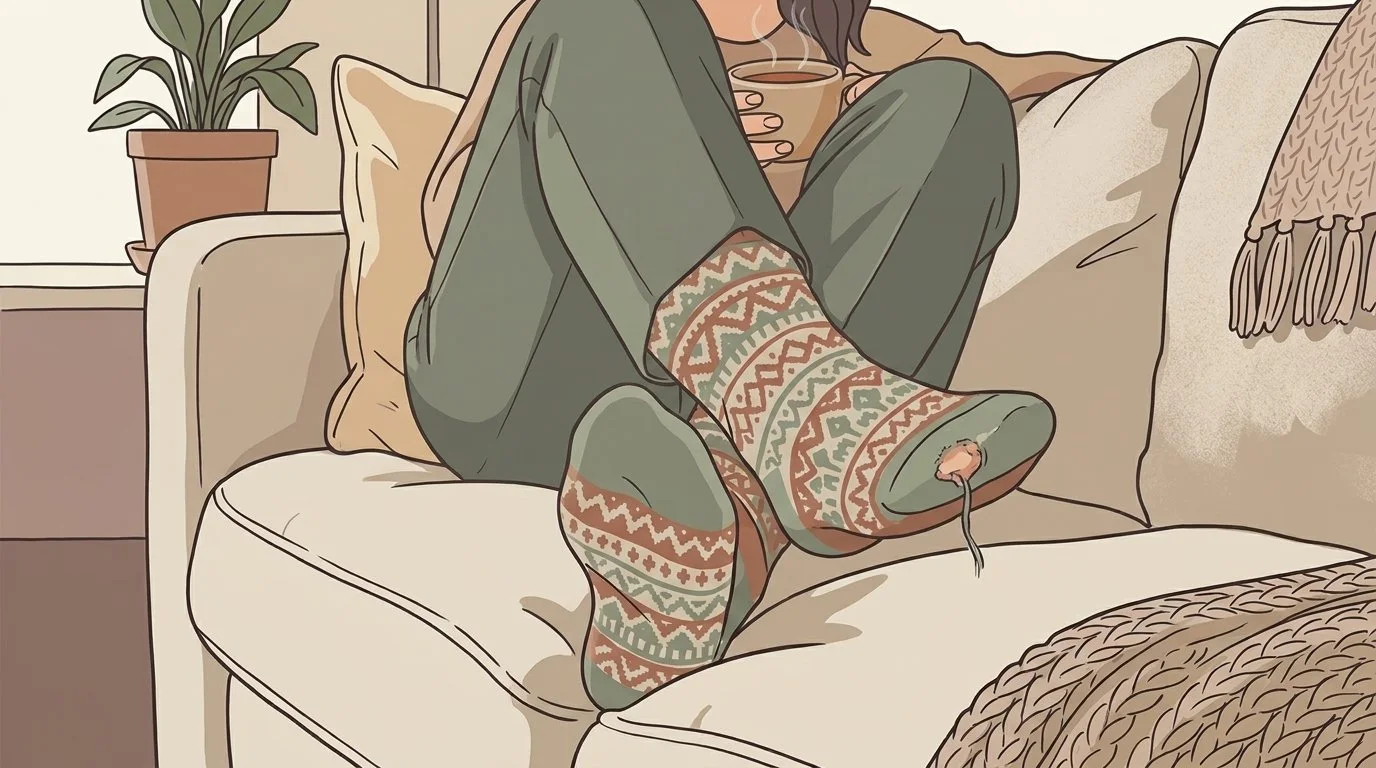
A simple line illustration of someone sitting with a cuppa, and a hole in their sock (AI-generated).
“Having a baby is a huge culture shock,” the counsellor says softly. “Making hundreds of micro-decisions every day in the face of so much perceived judgement is exhausting. No wonder you’re feeling overwhelmed.”
Oh my, yes! Micro-decisions. She gets it. Maybe I’m not going mad.
That feels right. The connection is settling in. I really do love my job.
The recurring theme this month, for me, my clients, and my supervisees, is overwhelm. Specifically, the sheer volume of micro-decisions, assessments, and perceived judgements we navigate every single day.
Take getting dressed in the morning. An outfit choice isn’t just about comfort anymore; it’s about presenting your own style, looking professional, being modest, being cool, fitting in, standing out, taking a feminist stance, or proving you don’t care what anyone thinks. And then comes the meta-overthinking: Am I self-obsessed for spending this much brainpower on a jumper?
Never mind the never-ending adult torment of, “What should we have for tea?”
When you layer those daily micro-decisions on top of the big questions - careers, housing, politics, climate change, or a full-blown existential crisis, it is no wonder our nervous systems are fried. Whether you are a teenager trying to figure out who you are, a young adult stepping into independence, or a seasoned practitioner supporting others, the sheer volume of information, misinformation, and unsolicited opinion we are exposed to turns simple choices into layered ethical dilemmas. Buying a cup of coffee becomes a question of fair trade, chain or independent store, single-use plastics, local economy, and whether you can afford £4.85 in a cost-of-living crisis.
Giddens (1991) argues that in modern times we are constantly exposed to global information and competing expert systems (health visitors, parenting books, algorithms); every tiny lifestyle choice, from what jumper you wear to what you feed a baby, becomes a "reflexive project of the self." Modern individuals are forced to make constant moral and identity-defining micro-decisions where previous generations could follow tradition. And I would argue that because this was written well before the social media boom, this impact is much greater now. Our mum in the North East is no longer just weighing her health visitor's advice against her mum's; she is weighing them against thousands of conflicting "micro-experts" curated by TikTok and Instagram.
I feel the weight in my chest just writing this.
Join me in a collective breath.
There are many studies, especially in the marketing world, that show that overwhelm of choice is more likely to cause paralysis, higher anxiety, lower confidence and less satisfaction with the result of any decision - eye-roll great.
So what do we do about it?
When everything feels heavy, we need practical ways to lighten the cognitive load. I use a three-pronged approach for myself and in sessions:
We can’t do it all.
What we can do depends on our energy levels.
Sometimes, you just have to draw a line.
Let’s break these down.
We can’t do it all (The Rule of Three)
Get everything out of your head and onto paper. Don’t overthink it or try to make it neat; just brain-dump. You can use the notes app on your phone, though there is something much more cathartic about physically putting pen to paper.
Once it’s all out on paper (or screen), cross off anything you cannot act on in the next few weeks, cross off anything that isn’t actually your responsibility, and anything you have no control over. From what’s left, underline only three things. Those three are your priorities for right now. That is it. Everything else goes on the bench.
2. Match your tasks to your energy (Spoons and Traffic Lights)
If you haven’t come across Spoon Theory, originally coined by Christine Miserandino to explain the daily energy limits of living with chronic illness, it’s a brilliant way to measure mental and physical capacity. Imagine starting the day with a set number of spoons, where every task costs a spoon. Some days you wake up with twelve; other days, you wake up with three.
Pairing this with a simple traffic light system helps take the guilt out of pacing yourself:
Green (Loads of spoons): Your energy is good, and thoughts are clear. Tackle your three priority tasks and enjoy the momentum.
Amber (A few spoons): You’re running low, or your thoughts are feeling foggy. Scale back - pick just one or two of your three priorities, and consider doing the bare-minimum version of it. Pace yourself through the day; if needed, take time to replenish those spoons; the rest can wait.
Red (Out of spoons): You are running on fumes. Today is not the day for big decisions or heavy tasks. Focus purely on basic care; your three things now become: food, water, rest - making it through the day.
3. Draw a line under the debate
If you have been going back and forth over a decision again and again, stop and look at the cost of the deliberation itself. Often, the mental toll of the internal debate is far worse than making the “wrong” choice. Whether it’s choosing a brand of nappies, sending an email, or deciding what’s for tea, sometimes the healthiest thing you can do is pick an option, draw a line under it, and deliberately let go of the debate.
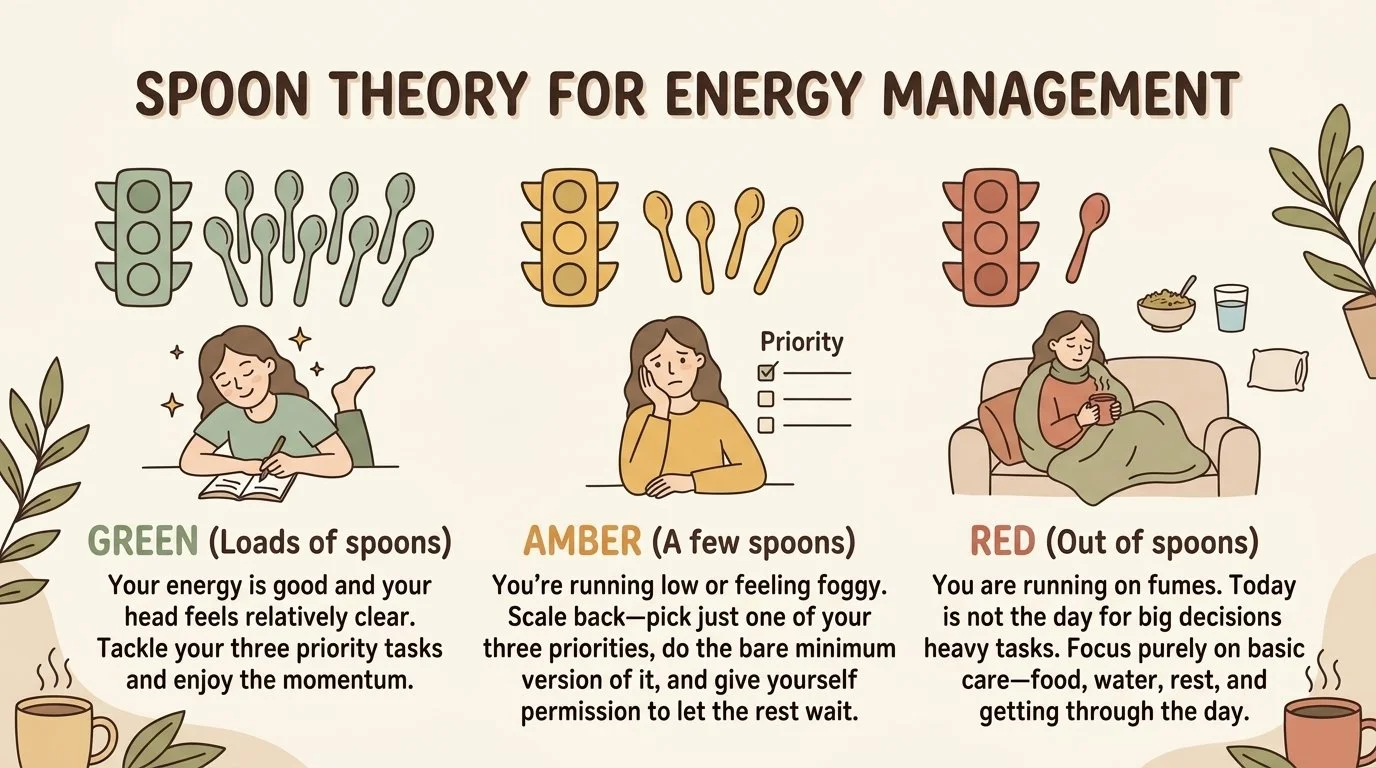
An illustration of the above information.
Sitting in the Overwhelm as Overwhelmed Practitioners
Of course, as the above fictional story shows, therapeutic professionals aren’t immune to any of this. We walk into the therapy room carrying our own mental load: how we store our notes, whether AI is evil, what’s for tea, cost-of-living worries, and sometimes, a hole in our left sock.
When an overwhelmed client sits opposite us, it is so easy to slip into the “expert trap.” We feel a sudden pressure to fix their panic, offer the ultimate coping strategy, or prove that we have our own lives completely together. Then we panic, thinking… "If I’m feeling stretched thin myself, how am I supposed to hold space for someone else’s chaos?”
The truth is, we don’t have to be the expert. No one is. In fact, pretending we are creates distance. When we acknowledge our own humanity, stop scrambling for ‘expert’ answers and start offering something far more real: a grounded, non-judgemental, human presence. We can sit alongside them, reminding them that they aren’t broken for finding life heavy, because it is heavy. This doesn’t mean we sink into the negativity together. We normalise, acknowledge it is hard, whilst still holding hope - a delicate but important balance. While remembering to take our own advice, check our own spoons, and bring the rest to supervision, we can keep the calm, safe space the therapy room needs.
Overwhelm and decision fatigue hit at every stage of life, young adult or parent, whether you’re sitting in the client’s chair or the therapist’s. When the noise of the outside world gets too loud, we all have to give ourselves permission to turn the volume down, pick three things, and leave the rest for tomorrow.
Are baby steps the answer to everything?
It’s lovely to share a few quiet moments with you today.
Until next time,
💛🌿 Helen
About the Author: Helen Gifford is a counsellor, supervisor, and author of ‘A Practical Guide For Working Therapeutically with Teenagers and Young Adults’.
Support this work: 📕 Order the Book: A Practical Guide for Working Therapeutically with Teenagers and Young Adults ☕ Buy me a toasted teacake: Ko-fi 🌿 Work with me: Clinical Supervision and Training via www.branchcounselling.co.uk
Author Note & Transparency: All case studies or stories are fully fictitious to illustrate the experiences many professionals face; no confidentiality has been broken. I recommend resources based on a combination of clinical experience and consideration of available evidence. These are offered for interest only and are not clinical recommendations. Please apply your own critical judgment.
References and Reading:
Giddens, A. (1991). Modernity and Self-Identity: Self and Society in the Late Modern Age. Stanford University Press.
Iyengar, S. S., & Lepper, M. R. (2000). “When Choice is Demotivating: Can One Desire Too Much of a Good Thing?” Journal of Personality and Social Psychology, 79(6), 995–1006.
Miserandino, C. (2003). The Spoon Theory. Originally published on But You Don’t Look Sick (butyoudontlooksick.com). The original personal essay explains how finite daily energy works when living with chronic illness, a metaphor that has since become a lifeline for neurodivergent folks, carers, and anyone navigating burnout.
Peng, M., Xu, Z., & Huang, H. (2021). “How Does Information Overload Affect Consumers’ Online Decision Process? An Event-Related Potentials Study.” Frontiers in Neuroscience, 15, 695852.
Pignatiello, G. A., Martin, R. J., & Hickman, R. L. (2020). “Decision Fatigue: A Conceptual Analysis.” Journal of Health Psychology, 25(1), 123–135.