
Some of you may know that I’m currently editing and refining a fiction novel focused on young adults and mental health. As often happens when starting a new creative project, I’ve found myself falling down several rabbit holes.
My book explores themes of family, friendship, love and loss, but also heavier topics of self-harm and suicidal ideation. Having worked with risk for over 20 years and as a counsellor for over 16 years, I felt naively comfortable exploring these topics with my main character, Sophie (who feels like a beloved friend herself by now). However, a recent conversation with my new friend on the Samaritans Media team, alongside some fresh research, reminded me of a crucial truth: what we do safely inside the counselling room is vastly different from what can be safely presented in public media.
Over the last decade, the media around our field has championed a message of openness. We encourage people to talk about mental health, reassuring them that asking someone directly about self-harm and suicidal thoughts won’t “plant the seed.” I have said these words many times myself to loved ones and other professionals. Avoiding the complex stuff is always more dangerous than discussing it. We bring these heavy topics out of the dark and into the light where support is accessible.
And yet, we also know that social contagion is real. I’ve seen this in schools myself, where waves of negative coping strategies can sweep a year group.
Whilst there have been other shows, a significant example we can look to is Netflix’s 13 Reasons Why (2017), which became a watershed case study for media ethics. Mental health charities raised concerns about the romanticisation of suicide, leading to warnings and, eventually, edited scenes.
Many of us create, curate and consume content. We also navigate supporting conversations and support with young people about their exposure. How do we, as practitioners, writers, parents, and educators, judge that thin line between realistic humanisation and harmful glamorisation?
The Science Bit
This dilemma sits directly between two competing psychological concepts:
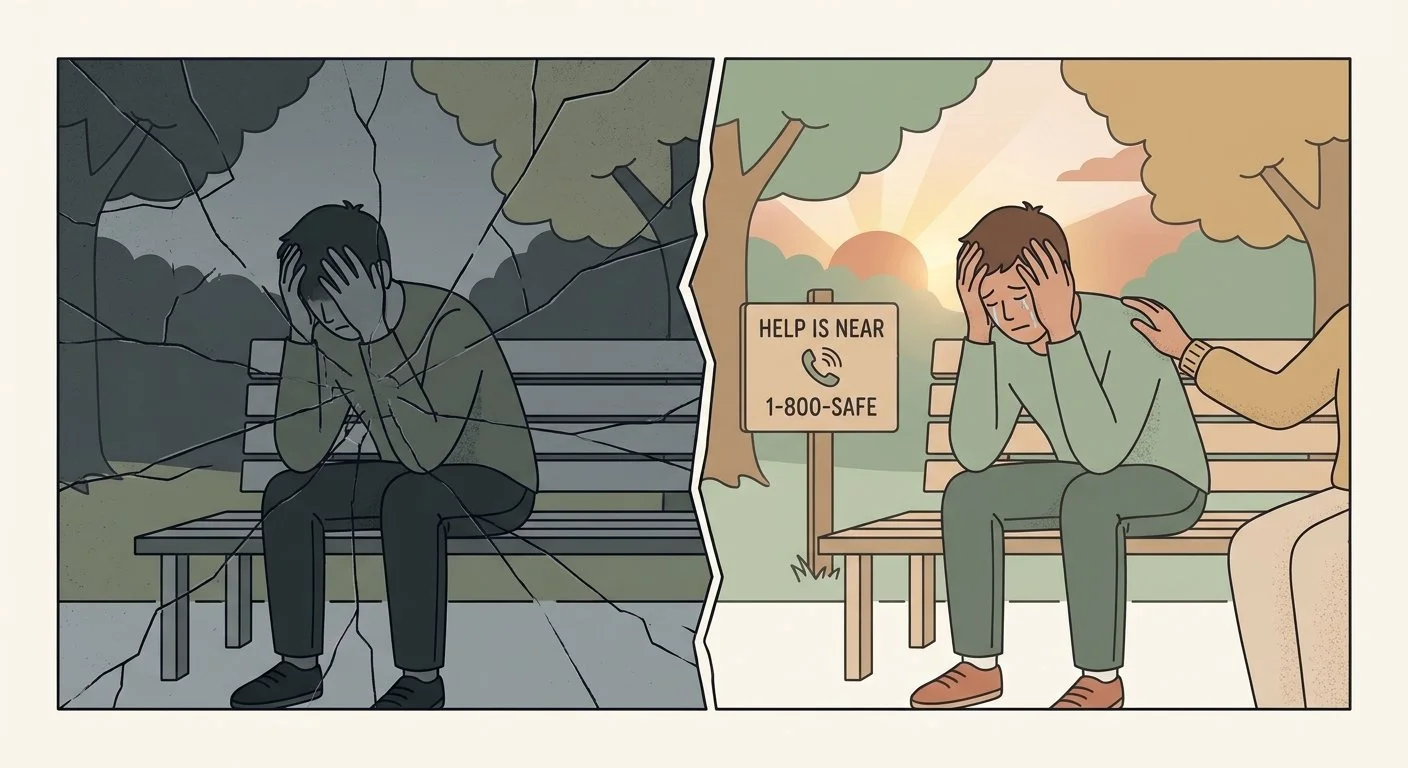
The Werther Effect (Social Contagion): A spike in suicides following high-profile, graphic, or sensationalised depictions of suicide. Named after Goethe’s 1774 novel The Sorrows of Young Werther, which was reported to have prompted a wave of copycat suicides across Europe.
The Papageno Effect (Protective Social Learning): Research shows that media focusing on coping, resilience, and surviving a crisis actively reduces suicidal ideation and behaviour. Named after the character in Mozart’s opera The Magic Flute who refrains from suicide after being shown alternatives.
If Good Is Unmeasurable, How Do We Judge?
I know historically I have often faced this question, especially in schools. Often distress is silent, and so progress (back to neutral) is also invisible to many, whereas harm leaves a measurable footprint (mortality rates, emergency admissions). While, as therapists or even in agency work, we can rely on wellbeing measures, this isn’t so simple on a community scale. So how do researchers measure the protective impact of narratives?
Help-Seeking Metrics: Tracking indicators such as crisis helpline volume, search engine traffic for support, and self-reported coping strategies following positive narratives (e.g., Niederkrotenthaler et al., 2021).
Controlled Exposure Studies: Measuring implicit suicidal cognition and distress tolerance after subjects engage with stories of recovery versus stories of unmanaged crisis.
What Does the Research Say About 13 Reasons Why?
A landmark NIH-funded study published in the Journal of the American Academy of Child and Adolescent Psychiatry (Bridge et al., 2019) found a 28.9% increase in suicide rates among US youth aged 10–17 in April 2017, the month immediately following the show’s release. This translated to an estimated 195 excess deaths over the following nine months. This is clearly highly concerning and needs exploration.
The series raised several red flags:
The central premise involves a protagonist exerting ultimate post-mortem control over her peers. To a young person feeling lonely, powerless, or invisible, this fantasy of revenge and huge significance is alluring. Loneliness among young adults is at an all-time high. UK data from NHS Digital and the ONS show that 29% of 16-to-24-year-olds report feeling lonely at least some of the time, compared to 15% of those aged 65 to 74. This is shocking; recent history has focused on loneliness of the older generation as the problem, with young folk as being social butterflies, encouraged to adopt a granny to support the elders (still a valuable cause, though!).
The show framed suicide as the neat result of a single dramatic trigger (a breakup or betrayal); this can lead to young people also seeing a breakup as a traumatic event that can’t be worked through. It can also limit awareness of the complexity of real life, which is always layered, complex, and cumulative.
The method was explicitly shown. Although Netflix eventually removed the scene in 2019 following pressure from health experts, the damage of that initial graphic depiction was done. Although graphic, it also came off as accessible, which is both dangerous and unrealistic.
Adults, school staff, and counsellors were largely portrayed as incompetent, dismissive, or harmful. The “bumbling” or unhelpful therapist trope doesn’t just make for lazy writing (which I am sure we are all sick of); it actively reinforces the terrifying idea that asking adults for help is useless.
Did the show do any good? An Annenberg Public Policy Centre study found that viewers who watched the entire season were slightly more likely to express sympathy to peers. However, for vulnerable individuals already experiencing distress, the graphic imagery and revenge framing significantly heightened risk.
Navigating the Line: Glamorisation vs. Humanisation
Media guidelines from Samaritans and Mind outline clear boundaries for content creators and clinicians alike:
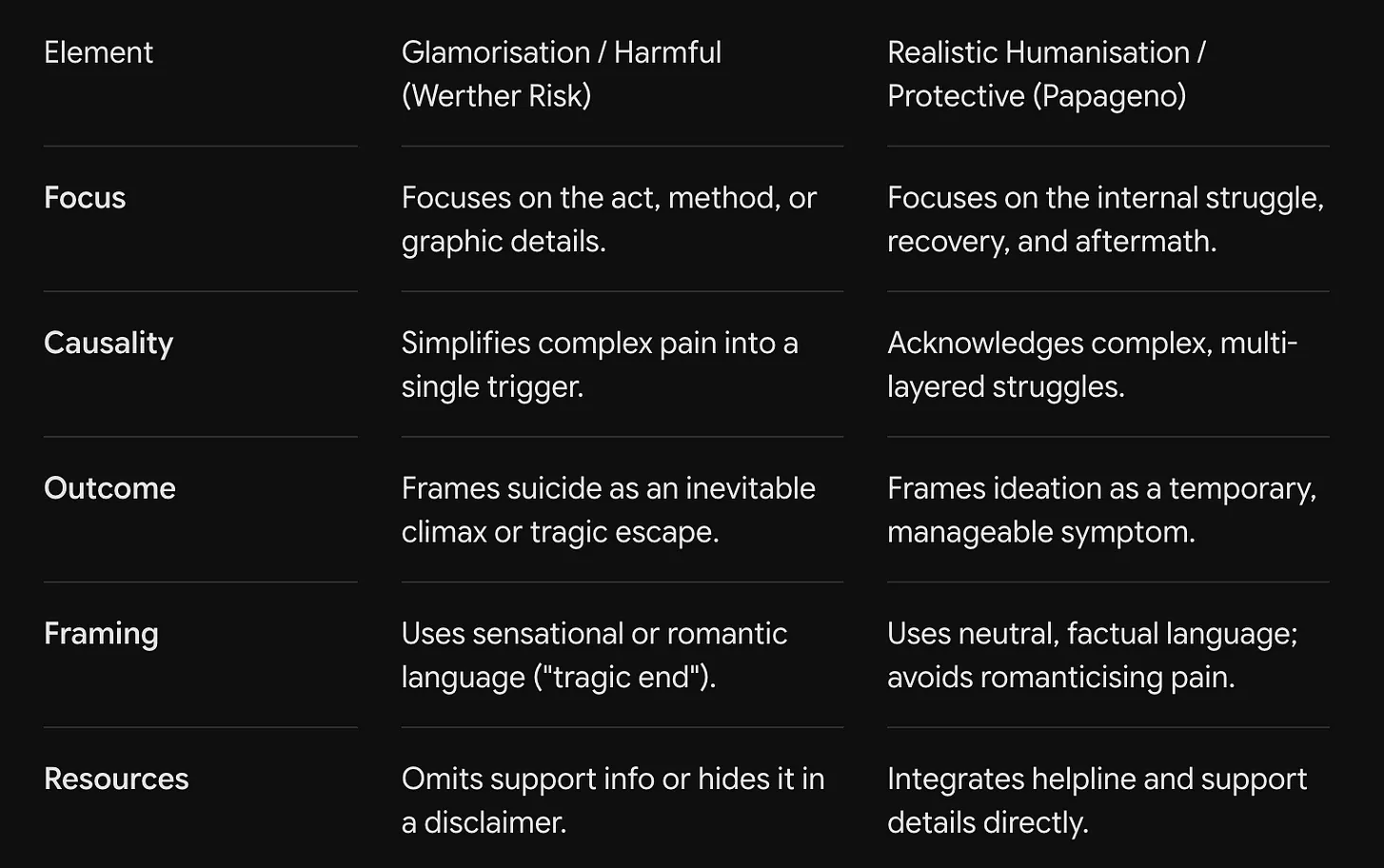
Graph exploring how we can move from the harmful Werther risk towards the protective Papageno depiction.
The Challenge of the Digital Age
While traditional media now follows strict production guidelines, much of what young people consume today comes via social algorithms:
Binge Culture & Delivery: 13 Reasons Why dropped all at once, allowing vulnerable teens to digest 13 hours of heavy trauma content in a weekend without time to debrief. Social media operates similarly: a young person can scroll through someone’s entire history of distress in a single sitting.
The “Doomscroll Loop”: Algorithms prioritise high-arousal emotions. Engaging with sad content when feeling down frequently builds an aggressive feedback loop of melancholy content.
Trauma-Dumping vs. Support: Peer support online can reduce isolation, but “vulnerability trading” can inadvertently create spaces where suffering becomes tied to social validation or identity.
Building Algorithmic Agency
So how do we support young people to keep safe? Rather than relying on simple binaries like “screens are bad” or “talking about mental health is always good,” we need to teach algorithm curation:
Audit the Feed: Encourage clients to ask: Is this account feeding my curiosity, or my anxiety? How do I feel after reading this?
Curate with Intent: Remind young people that their feed is not a direct reflection of reality, but a gallery they have the power to curate.
The Good?
But we are not just here for scaremongering. Media does provide space for representation, a sense of not feeling alone, a space to promote conversation, sharing of how to access support and help - represented within the narrative, not just the token helpline before the credits roll.
A clear example of the Papageno effect is Logic’s track. The song's release and its two major TV performances (the 2017 MTV VMAs and the 2018 Grammy Awards) were associated with a 6.9% increase in calls to the National Suicide Prevention Lifeline (+9,915 calls above expected) and a 5.5% reduction in suicides among 10-to-19-year-olds over the peak attention periods (an estimated 245 lives saved!!).
A UCLA study further exploring ‘13 Reasons Why’ found that 84% of teens reported that watching characters navigate mental health issues made them more likely to discuss mental health with their parents, peers, or partners. And as we have now learned…researchers emphasised that TV acts as a positive conversational catalyst only when media portrays struggles authentically, credibly, and supportively, rather than graphically or hopelessly.
The Consensus: Openness itself does not cause harm. The framing determines whether the outcome is contagion (Werther) or healing (Papageno).
What Does This Mean for Sophie’s Story?
Research on the Papageno Effect confirms that stories featuring authentic coping mechanisms decrease suicidal ideation and increase help-seeking behaviour.
Without giving away any spoilers, Sophie’s story is rooted in hope. It strips away romantic tropes around suffering and revenge. It doesn’t treat mental health struggles as a poetic aesthetic, but reflects the messy, complex, and ultimately treatable reality of human life. But I am looking at some small changes. The topics that I confidently explore in the therapy room don’t easily translate to the page. Just because I can share the therapeutic experience well doesn’t mean I can control the space someone is in when reading my words, and because of that, I must lean into caution, making some changes.
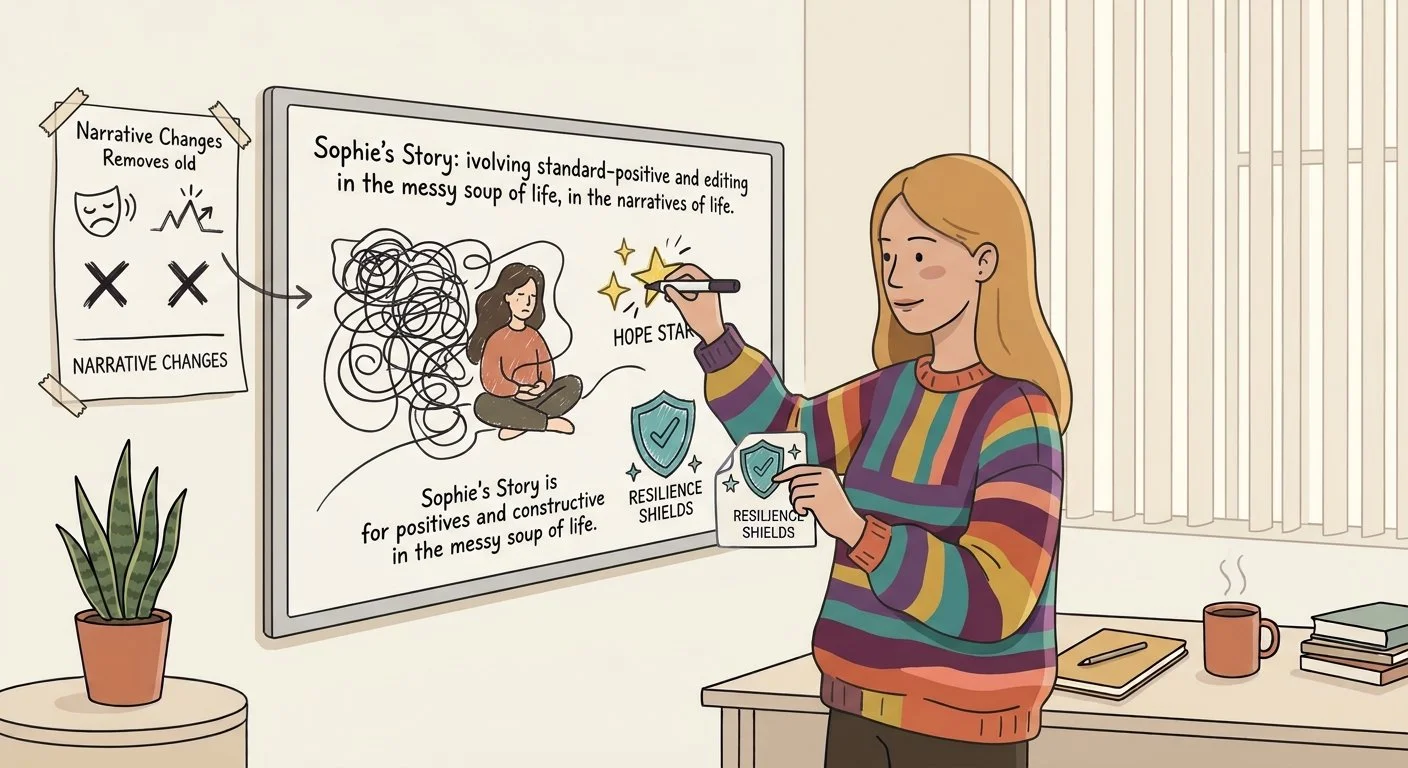
Me in one of my many stripy jumpers plotting and planning Sophie’s story.
As professionals, writers, and carers, our role isn’t to silence hard conversations - it’s to ensure that they are rooted in reality and hope.
It’s lovely to share a few quiet moments with you today.
Until next time,
💛🌿 Helen
About the Author: Helen Gifford is a counsellor, supervisor, and author of ‘A Practical Guide For Working Therapeutically with Teenagers and Young Adults’.
Support this work: 📕 Order the Book: A Practical Guide for Working Therapeutically with Teenagers and Young Adults ☕ Buy me a toasted teacake: Ko-fi 🌿 Work with me: Clinical Supervision and Training via www.branchcounselling.co.uk
References:
Bridge, J. A., et al. (2019). Association Between the Release of Netflix’s 13 Reasons Why and Suicide Rates in the United States. JAACAP.
Niederkrotenthaler, B., et al. (2010). Role of media reports in completed and prevented suicide: Werther v. Papageno effects. The British Journal of Psychiatry.
Niederkrotenthaler, B., et al. (2021). Association of Logic’s song “1-800-273-8255” with calls to the National Suicide Prevention Lifeline and suicides in the USA. BMJ.
Arendt, F., et al. (2019). Investigating Harmful and Helpful Effects of 13 Reasons Why Series. Communication Research.
Samaritans Media Guidelines: Guidance for Reporting Suicide & Portraying Suicide in Media.
APA Health Advisory on Adolescent Social Media Use (2023). Guidelines on digital literacy and adolescent psychological safety.
Mental Health Toolkit for Storytellers https://www.scholarsandstorytellers.com/mental-health-toolkit-for-storytellers